A Visa option signals a payment route, not Australian authorisation, withdrawal speed or proof of a casino’s claims.

A Visa logo can look like a simple answer to a payment question. In Australia, it cannot answer the more important question of whether an online casino is legally permitted to offer its games. The payment method and the operator’s legal status are separate matters. One does not establish the other.
The Interactive Gambling Act 2001 makes it illegal for operators to provide real-money online casino games to people in Australia. The prohibition covers casino-style services such as poker and table games, as well as pokies. It is directed at the provision of the service, not at the branding or payment route displayed around it. A cashier showing Visa does not change what the operator is offering.
That distinction is easy to miss because payment screens are designed to make a transaction feel routine. A familiar card logo can suggest that a service has been checked or approved. It does not mean that. Visa is a payment brand; it is not an Australian authorisation for online casino games. Nor does a successful card transaction decide whether an operator may provide those games to someone physically located in Australia.
When choosing a casino that accepts Visa in Australia, check the available payment details alongside the operator’s licensing information. This list offers a concise reference to the details provided for each operator.
Neospin
Neospin is listed with a Curacao Gaming Control Board licence, OGL/2023/176/0095, held by Hollycorn N.V.
Ricky Casino
Ricky Casino lists crypto payouts in under an hour and PayID payouts in 1–3 business days. The minimum deposit is A$20, or A$30 to qualify for the bonus.
7Bit Casino
7Bit Casino is operated by Dama N.V. and is listed as licensed in Curacao.
Rollero Casino
Rollero Casino is listed with a Curacao Gaming Control Board licence, OGL/2023/176/0095, held by Hollycorn N.V.
Lucky Dreams
Lucky Dreams is listed as licensed in Curacao. Its minimum deposit via POLi is A$20.
LevelUp Casino
LevelUp Casino is operated by Dama N.V. and is listed with a Curacao eGaming licence, OGL/2023/174/0082. Its minimum deposit is A$15.
DragonSlots Casino
DragonSlots Casino is listed as licensed by the Curacao Gaming Authority, with Jumpman Gaming Ltd as operator.
House of Pokies
House of Pokies lists an international iGaming licence, though the source does not name the jurisdiction. PayID payouts are listed as taking 1–24 hours; the minimum deposit is A$30, or A$10 via PayID.
Roby Casino
Roby Casino is operated by Roby Games Ltd and is listed as licensed by Curacao eGaming.
JustCasino
JustCasino is listed as licensed by the Curacao Gaming Control Board.
I have seen how quickly those ideas become mixed together. People treat acceptance of a card as a practical seal of approval: if a payment can be made, the business must be legitimate. That reasoning is unreliable here. Payment availability describes a transaction route, while the law addresses the operator’s provision of prohibited interactive gambling services. Different questions. Different answers.
The same applies when a site describes itself as an Australian online casino or presents pokies in a mobile-friendly format. Location in a page title, an Australian dollar display, or a Visa symbol does not alter the legal character of the service. The relevant issue is not whether the cashier appears familiar. It is whether real-money casino games are being offered to people in Australia.
The Australian Communications and Media Authority, or ACMA, is the regulator that enforces the Interactive Gambling Act. Its role concerns the law’s restrictions on operators. That enforcement framework should not be confused with an approval process implied by payment options. A casino does not become lawful to operate in Australia simply because a card brand appears among its payment methods.
There is also an important distinction between the operator’s position and the player’s. The Act prohibits operators from providing the covered services, but it does not explicitly make an individual player’s use of an offshore site a criminal offence. That does not amount to a recommendation, a guarantee of access, or a statement that the service is protected. It describes the difference between the legal rule directed at operators and the position of a person using such a service.
 Payments & Crypto for Australian CasinosThis page brings together Australian casino searches for cards, bank payments, e-wallets and cryptocurrencies, rather than game or bonus topics.
 Casino sites claiming to accept Osko in AustraliaLearn why search labels do not prove Osko acceptance, and what remains unverified about deposits, withdrawals and Australian availability.
Australian consumer law does not protect players who use offshore casinos. That matters when a transaction or account dispute arises: the presence of a recognisable payment method should not be mistaken for local consumer safeguards. A familiar checkout experience is not the same as Australian legal protection. The distinction is practical, not academic.
Searches for Australian pokies that accept Visa often combine two issues in one phrase: whether a payment method appears to be available and whether an online casino is an appropriate service for Australian residents. Those issues need to be separated before any payment detail is considered. A Visa reference can speak only to a claimed payment option; it cannot override the law governing online casino games.
This is why a page describing a Visa mobile casino should not be read as confirmation that the casino is authorised to provide real-money games in Australia. “Accepted” is a narrow payment claim. It is not a legal status, a local licence, or evidence of consumer protection. Payment language can sound definitive while saying very little about the operator’s obligations.
The boundary is straightforward. The law restricts operators from supplying real-money online casino games to people in Australia. ACMA enforces that law. The Act does not explicitly criminalise players for using offshore sites, but Australian consumer law does not protect those players. A Visa logo changes none of those points.
A cashier is not a licence.
Legal Status
The Interactive Gambling Act 2001 makes it illegal for operators to provide real-money online casino games to people in Australia. A Visa logo does not change this legal status or provide local authorisation.
A statement that Visa may be accepted more widely than Amex is a comparison, not a guarantee about any particular cashier. That distinction matters. A specialist casino review has made the broader-acceptance comparison, but acceptance can vary between operators and change over time. The claim does not establish that a named site currently takes Visa, or that every Visa card will work there.
I read payment labels narrowly. “Visa accepted” describes a possible payment option; it does not, by itself, confirm the conditions attached to making a deposit. It says nothing definite about which cards are eligible, what currency a cashier offers, whether a transaction will be approved, or what amount can be entered. Those details belong to the individual operator’s current terms and payment interface. The label is a starting point, not a complete set of terms.
That is why a general comparison cannot settle whether a casino deposit by Visa is available in a specific case. Even if Visa appears more often than Amex across the sites covered by a review, that does not identify the sites, establish how the review assessed them, or confirm that its information remains current. A category-level observation is not a live check of a particular cashier.
The same limit applies to phrases such as “Visa deposit” or “deposit via Visa”. They describe the intended route in broad terms, but they do not reveal the steps or conditions that apply at a given operator. The presence of a Visa logo, where shown, should not be treated as proof that every card bearing that logo can be used successfully. Availability and approval are separate questions.
 Casinos That Accept POLi in Australia: What to VerifyLearn why POLi’s association with bank-linked payments does not confirm casino acceptance, and how to distinguish general payment habits from cashier evidence.
 CashToCode Casinos in Australia: What’s VerifiedLearn what the available evidence says about CashToCode deposits, casino acceptance and payouts, and why ACMA enforcement matters in Australia.
The words “best” and “accept Visa deposits” can also blur two different claims. One is about whether Visa is offered as a payment method. The other is a judgement about which operator is preferable. The first cannot establish the second. Acceptance alone says nothing about the quality of a site or the suitability of its terms, and it does not provide a basis for calling any operator the best choice.
From the operational side, a cashier is not just a row of payment logos. The account also has to pass the operator’s checks before financial transactions are allowed. Online casinos commonly require customers to complete a Know Your Customer assessment before they can transact. That identity review is a separate condition from whether Visa appears among the available payment methods. A payment option can be displayed while account checks remain incomplete.
This separation is easy to miss because payment descriptions compress several stages into a short phrase. “Visa deposit” sounds like one settled capability. In practice, the phrase may refer only to a method the operator says it supports; the individual account’s eligibility and transaction approval remain distinct. The wording does not prove that a deposit has been processed, or that the cashier will present the same options to every account.
A useful reading is therefore deliberately modest: a specialist review’s comparison suggests Visa may be accepted more broadly than Amex at Australian online casinos. It does not establish universal acceptance, confirm a particular operator’s current arrangements, or specify any deposit terms. Anything more specific needs to come from the operator’s own current cashier and conditions, not from the comparison alone.
I have seen how a broad payment claim can be mistaken for a complete promise. It is not one. The method label answers only a narrow question: whether Visa is presented as an option. Account checks, operator-specific terms and transaction approval sit outside that simple label. Keeping those points separate avoids treating a general comparison as evidence for details it does not actually provide.
A comparison can put Visa acceptance in a headline and still leave the central question unanswered: what does the comparison actually establish? A payment-method label is a narrow claim. It does not, by itself, confirm that a particular site accepts Visa, explain the conditions attached to a transaction, or make the site suitable for people in Australia.
I have seen how easily a broad label turns into an implied recommendation. “Best” sounds like a conclusion, but it may only describe how a publisher has arranged its entries. The criteria might concern payment options, other site features, or the publisher’s own scoring method. Unless those criteria are clear, the ranking says little about the basis for the order. A polished table is still an editorial presentation, not proof.
The available comparison between card brands is limited. A specialist review has reported that Visa may be accepted more broadly at Australian online casinos than American Express. That is a qualified comparison, not a current census of operators and not confirmation about any named site. Availability can change, and a general statement about relative acceptance cannot settle an individual case. Small distinction. Important one.
This is why lists described as Visa casinos should be read as claims to examine, rather than as verified directories. The wording may group sites under a payment heading, while the detail behind that heading varies: one entry might be based on a cashier listing, another on a review, and another on information that has since changed. Without a clear basis and date for each entry, the group label can look more definitive than it is.
The separate ranked operator panel on this page has a different purpose and should not be read as a Visa acceptance list. A ranking is not an endorsement, and its position does not prove that Visa is available there. Nor does a site appearing in a panel establish that the service is lawful for Australian residents. Presentation and legal status are separate matters.
That distinction matters particularly in Australia. The Interactive Gambling Act 2001 prohibits operators from providing real-money online casino games to people physically in Australia. Australian consumer law does not protect players who use offshore casinos. A comparison table cannot alter either point, and a payment logo cannot supply legal protection.
I would also separate the labels that are often bundled together. “Visa casino” can mean a site said to accept Visa, a site with Visa shown among payment options, or a site whose deposit process has been tested and described. Those are not interchangeable claims. A reference to Visa acceptance does not establish that every card will work, that every account is eligible, or that the same route is available to every customer. No inference should be stretched beyond the wording and evidence attached to it.
One specialist review reports that Visa may be accepted more broadly at Australian online casinos than American Express, though this is a qualified comparison and not a current census.
The same care applies when a comparison uses a strong verdict. “Top” or “best” is promotional language unless the method behind it is transparent and relevant to the specific question. A high position may reflect an overall editorial score rather than verified Visa availability. Conversely, a low position does not prove that a payment method is unavailable. Ranking and payment acceptance measure different things.
The practical reading is modest: treat a broad Visa comparison as a starting label, not an assurance about a particular operator. The only supported market-level contrast is that one specialist review describes Visa as potentially more widely accepted than Amex. It does not identify which individual sites accept Visa or establish their terms. A comparison can organise claims. It cannot turn them into guarantees.
A Visa option in a casino cashier answers a narrow question: whether the operator presents Visa as a way to fund an account. It does not, by itself, say how winnings can be paid out or how quickly they would arrive. Deposit and withdrawal rules are separate parts of the payment arrangement, even when the same card appears in both discussions.
I have seen payment labels treated as if they described the whole journey. They do not. A deposit method can be available while a withdrawal follows different conditions, or while the operator does not return funds to that card at all. The word “instant” is especially easy to overread: it may describe one step in a payment process, not access to winnings or completion of a withdrawal.
 Casinos That Accept PayID in Australia: What Is VerifiedLearn why a PayID logo does not confirm Australian customer access, casino transaction support or availability in the cashier.
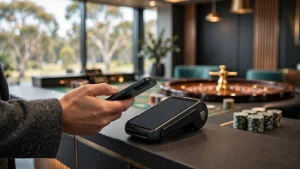 Casinos That Accept Google Pay in AustraliaMobile wallets are accepted in almost all everyday settings, but that does not establish casino support; learn what to verify in cashier…
That distinction matters for claims about instant Visa withdrawals. Visa acceptance is not evidence of instant payout, and a phrase such as “instant withdrawal” should not be attached to Visa merely because Visa appears among deposit options. Nor does the label establish that Visa withdrawals are available. Those are separate claims, requiring separate terms.
The available Amex example shows why the distinction is practical rather than semantic. A specialist review reports that some casinos may not permit winnings to be withdrawn to Amex, or may apply an extra withdrawal fee. The same kind of review gives a clearance period of up to five days for Amex casino withdrawals. Those statements concern Amex and a particular review’s account of conditions; they cannot be transferred to Visa or treated as a universal timetable.
A “fast” payment description can also leave out what the timing refers to. The distinction between a deposit being accepted and a withdrawal clearing is consequential: the first concerns money entering an account, while the second concerns money leaving it. Even where a site uses one card brand in both contexts, the available withdrawal route and its terms must be read as their own matter. Card branding is not a timing guarantee.
Attention: The presence of a deposit method does not guarantee that the same route is available for withdrawals or that payouts will be instant.
This is why a comparison that groups payment options under a single “instant” label can mislead. It collapses different directions of travel into one promise. Deposit acceptance, withdrawal eligibility, fees and clearance timing are not interchangeable details. If one is stated, it should not be treated as proof of the others.
The same caution applies to claims about “instant Visa pokies” or a new Visa casino. Those phrases can suggest a simple combination of card access and immediate winnings, but neither the word “new” nor a Visa logo establishes the withdrawal terms. A payment method says little about how a withdrawal is handled.
The useful distinction is plain: acceptance for deposits does not establish withdrawal access, and withdrawal access does not establish speed. The Amex example illustrates that conditions can vary and that a published timeframe can be tied to a specific card and review. It provides no basis for assigning Visa the same route, fee or timing. Separate terms. Separate claims.
A Visa logo or payment option says nothing about whether an online casino may lawfully serve people in Australia. The distinction matters because the Interactive Gambling Act 2001 places the prohibition on operators: providing real-money online casino games to people physically in Australia is illegal. A site’s willingness to take a card does not alter that rule, nor does it create local authorisation.
The Australian Communications and Media Authority, or ACMA, oversees enforcement of the Act. Offshore services may be subject to blocking and other enforcement measures, so a page loading or a cashier displaying Visa is not evidence that the service is approved for the Australian market. Availability can change; legal status does not follow the payment button.
 Casinos That Accept Neosurf in Australia: What to CheckLearn why a Neosurf mention does not verify an Australian casino payment option, and why a deposit claim cannot confirm a withdrawal…
 Casinos That Accept Bitcoin in Australia: PaymentsLearn how Bitcoin deposits move from broadcast to casino credit, and what to check about confirmations, network fees, legal limits and withdrawals.
The position of an individual player is different from the operator’s. The Act does not explicitly make it a criminal offence for a player to use an offshore casino. That distinction is often flattened in commercial copy, either into an implication that the service is lawful because the player is not criminalised, or into a warning that players face the same prohibition as operators. Neither is an accurate reading. The law’s central restriction is directed at the supply of the service.
That difference should not be mistaken for consumer protection. Australian consumer law does not protect players who use offshore casinos. If a dispute arises over an account, a payment or access to funds, the operator is not thereby brought within Australia’s ordinary consumer safeguards. A card network’s involvement does not bridge that gap. Payment access is a transaction feature, not a local remedy.
I have seen payment acceptance treated as a shortcut for judging a site: if the cashier accepts a familiar card, the business must be established or safe. That inference does not hold. The cashier answers a narrow operational question. It cannot establish that the operator is permitted to offer casino games here, that Australian protections apply, or that a dispute can be resolved through local channels. Different questions. Different consequences.
So the phrase “casinos that accept Visa in Australia” describes a payment claim, not a category of locally authorised casinos. The same is true of debit-card wording or any other variation: a listed method cannot override the Act. Nor does the absence of explicit player criminalisation amount to an endorsement by Australian authorities.
The practical caveat is therefore broader than whether a card transaction can be attempted. Offshore casino services sit outside the protections available for locally regulated consumer activity, while operators offering the prohibited service may face enforcement. That is the legal context behind any claim of card acceptance. A logo is not a licence.
A Visa logo in a payment menu describes a payment option, not the content of a site or the terms attached to any particular game. I keep those questions separate. A card brand can be discussed at the level of payment acceptance; it does not establish that a particular game is offered, that it can be accessed from Australia, or that a payment method works differently for one title than another.
A specialist review has reported that Visa may be accepted more broadly at Australian online casinos than American Express. That is a limited comparison between payment methods. It does not verify a particular operator’s current cashier, and it says nothing about which games are available or the rules attached to them. “More broadly accepted” is not a universal acceptance claim.
The distinction matters because casino language often places payment and content side by side. A page may discuss Visa and games in the same breath, but proximity is not evidence of a game-specific Visa rule. A payment method does not, by itself, determine a game’s features, eligibility, or availability. Nor does a description of a game establish that Visa can be used for a transaction connected with it.
 Casinos That Accept Mastercard in AustraliaLearn how Australian law and payment evidence shape Mastercard claims. ACMA enforces the Interactive Gambling Act, which bars online casino services in…
 Casinos That Accept Neteller in Australia: What to CheckLearn why a Neteller cashier listing does not confirm Australian access, and why this article cannot verify casino acceptance or withdrawal promises.
I have seen this kind of category blur turn a modest payment statement into a much larger impression. A reference to Visa can sound like confirmation of an entire casino experience. It is not. The only inference supported by the comparison is about relative acceptance as reported by that review; it cannot be extended to a named site, a particular title, or a special payment option for game play.
The legal boundary also remains separate from the payment question. Under Australia’s Interactive Gambling Act 2001, operators are prohibited from providing real-money online casino-style games to people in Australia. A payment method does not alter that rule or make prohibited content lawful. These are different questions, with different consequences.
So descriptions joining Visa with casino games should be read narrowly. They may concern payment acceptance, but they do not confirm a title, its availability, or a distinct Visa arrangement for it. The label does not travel that far.
Payment habits in Australia are not confined to one kind of card. Contactless credit and debit payments are accepted almost everywhere, so tapping a card is a familiar part of everyday spending. That broad familiarity helps explain why Visa is often considered alongside other payment routes when people compare online services. It does not make every service’s cashier identical.
Broadly used across Australia for everyday spending, including Visa credit and debit cards.
Services like Google Pay and Apple Pay that allow payments without a physical card.
Flexible payment routes, including services like PayPal, linked directly to bank accounts.
Mobile wallets are part of the same routine. Google Pay and Apple Pay are accepted almost everywhere in Australia, giving consumers another way to pay without presenting a physical card. In practice, the choice can come down to what is already set up on a device, what a merchant supports and how a payment is meant to be made. Familiarity with the wallet is not the same as universal availability at every online operator.
Australians are also comfortable moving between cards, mobile wallets and services linked to banks, including PayPal. From the business side, that flexibility is unsurprising: customers tend to use the route that fits the transaction and their own habits, rather than remain loyal to a single payment format. The payment landscape is mixed by design.
That context matters when Visa is discussed in connection with an Australian casino. A card’s widespread everyday use can make it a familiar option, but the local payment culture does not determine what an individual cashier offers. The same is true of wallets and bank-linked services. Familiarity is not acceptance.
I have seen payment pages treated as if they were simple mirrors of what people use elsewhere. They are not. A method can be common across Australian shops and still be subject to separate decisions in an online service’s payment interface. The useful distinction is between a method people know how to use and a method made available for a specific transaction.
So Visa sits within a broad set of familiar Australian payment habits, alongside contactless cards, mobile wallets and bank-linked services. That wider context explains why people may switch between options; it should not be mistaken for a promise about any particular cashier. A small distinction, but an important one.
A card appearing in a casino cashier as a deposit option does not, by itself, show that winnings can be sent back to that card. Deposit and withdrawal routes are separate conditions. In my experience, the distinction is easy to miss when a payment method is presented as a single feature.
Amex illustrates the point. A specialist casino review reports that an Amex withdrawal may depend on having made an earlier deposit with Amex, and that some Australian-facing casinos do not offer withdrawals to that card. The same type of review notes that each casino sets its own Amex deposit and withdrawal limits, so the conditions can differ between operators. These are descriptions of reported Amex arrangements, not a rule that applies across every casino.
For Visa, the practical implication is narrower: deposit acceptance does not establish that a casino will return winnings to a Visa card. A “Visa withdrawal” label would need to be supported by the casino’s own cashier terms. The relevant details are whether Visa is an eligible withdrawal route, whether a prior Visa deposit is required, and what limits or alternative routes apply. None follows automatically from seeing Visa among deposit methods.
I have seen payment pages make a method look uniform while the transaction rules differ by direction. The cashier may accept one card for funding and route withdrawals elsewhere, or impose conditions specific to that payment type. A logo is not a payout policy.
A specialist review notes that Amex withdrawals may require a prior deposit, may be unsupported by some casinos, and can have clearance periods of up to five days.
That matters for searches about Visa withdrawal at online casinos or pokies. The phrase can sound like a single capability, but it combines two separate checks: whether Visa can fund an account and whether it can receive a withdrawal. The Amex examples show why the second check deserves its own line in the terms. They do not establish Visa’s withdrawal availability, processing time, or limits.
The useful distinction is simple: confirm the withdrawal route itself, rather than treating a deposit option as proof of a matching payout route. Different directions, different rules.
A Visa logo and an Amex logo do not tell the same story about acceptance. A specialist affiliate review reported that some online casinos do not accept Amex and characterised Visa as more broadly accepted at Australian online casinos. That is a limited comparison, not a dependable rule for every operator or a confirmation that a Visa transaction will be available in a particular case. Payment arrangements can change.
I have seen card brands treated as if they were interchangeable in promotional copy. They are not. A casino may support one network and not another; the brand alone says nothing about whether a specific card, issuer or transaction will work. Nor does a general claim that a site takes Visa establish its fees, processing time or other payment conditions. Those are separate terms, not details that can be inferred from the logo.
The phrase “pay by Visa” can sound like a straightforward feature. In practice, it is only a statement about a possible payment channel, and even that needs to be specific to the operator and current terms. It should not be read as a guarantee of access or as evidence that other card options are available. Narrow claim. No more.
There is also a legal boundary that card acceptance cannot change. Under the Interactive Gambling Act 2001, operators may not provide real-money online casino games to people in Australia. A payment option does not make such a service lawful. Offshore casino use is not protected by Australian consumer law, either.
So, when a comparison describes Visa as more widely accepted than Amex, the useful meaning is modest: one specialist review drew that distinction, while also noting that some sites did not take Amex. It does not identify which casino accepts Visa now, or establish that a particular payment would be permitted or completed. Those points should not be blurred together.
A Visa logo beside a bonus headline can make the two look connected. It proves neither that an offer exists for a particular customer nor that using Visa qualifies someone for it. Payment acceptance and promotional eligibility are separate questions; one cannot be inferred from the other.
I have seen how a short label can carry more weight than its wording supports. “Visa bonus” may simply sit beside a payment reference, while the actual conditions—if an offer is presented at all—are elsewhere. That label is not a promise of a bonus, a confirmation of eligibility or evidence that a payment will be accepted.
Identity checks are another separate step. Online casinos typically require a Know Your Customer assessment before financial transactions. Completing that assessment is not the same as qualifying for an offer, and it does not settle how a payment method is treated.
In Australia, this distinction also sits within a wider legal boundary: the Interactive Gambling Act 2001 prohibits operators from providing real-money online casino games to people in the country. A bonus description does not change that status. Nor does a card brand.
The practical reading is narrow. A Visa reference says nothing by itself about bonus terms or eligibility. Promotional language is not a payment condition, and payment branding is not proof of a valid promotion. Separate claims; separate scrutiny.
Check the casino’s cashier for American Express as a deposit option. Acceptance varies by casino, and a payment logo does not establish that the operator is authorised to offer online casino games in Australia.
Some casinos allow withdrawals to American Express, but not all do. You generally need to have deposited with Amex first, and a withdrawal may take up to five days to clear.
Check with American Express or your bank, as either may block gambling-related payments to a particular website. You can also check whether the casino’s cashier currently accepts Amex.
Amex deposits are typically free, but a casino may add a 1.5% surcharge, and Amex currency conversion can incur a 3% fee. Withdrawal fees may also apply, depending on the casino.
Yes. Each casino sets its own Amex deposit and withdrawal limits, so check the limits shown in its cashier or payment terms. Amex limits are usually higher than those for Visa and Mastercard.
Amex deposits typically have no fee, but a casino may charge a 1.5% surcharge. A 3% currency conversion fee may also apply.