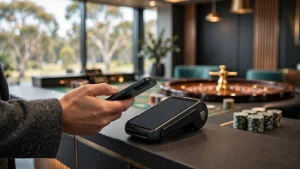
Offshore status, crypto payments and access checks shape what anonymity can mean when using online casinos from Australia.

The legal distinction is between the service and the person using it. Under the Interactive Gambling Act 2001, an operator licensed in Australia cannot provide online casino games to people in the country. That covers casino-style games offered for real money, including pokies and table games. An Australian licence is not a route for a domestic business to offer this category of online gambling to local residents.
Offshore crypto casinos sit on the other side of that line. They do not hold Australian licences and are not supervised within Australia’s gambling framework. The use of cryptocurrency does not give an operator local authorisation, and a site’s own claims about where it is licensed do not change its status in Australia. The practical point is plain: these services are outside the system that regulates Australian gambling businesses.
That distinction is easy to blur in marketing. “Anonymous” can sound like a description of legal status, but it is not. It says nothing by itself about whether a casino is authorised, whether it checks a user’s identity, or what happens if a dispute arises. A crypto payment method does not make a platform Australian-regulated, and it does not turn an offshore service into a local one.
The regulator under the Act is the Australian Communications and Media Authority, or ACMA. Its role belongs to the Australian regulatory framework; an offshore casino is not brought within that framework simply because it accepts customers located here. From the operator’s side, the legal restriction concerns providing prohibited online casino services to people in Australia. From the player’s side, the position is different: an individual is not committing a criminal offence merely by placing a bet with an offshore online casino.
That does not amount to approval. It is a narrow statement about player liability, not a declaration that the operator may lawfully serve Australians, nor a recommendation to use an offshore site.
There is also a concrete consequence to being outside Australian oversight. An offshore crypto casino offers no consumer protection under Australian gambling regulation. If a balance is withheld, a withdrawal is disputed, or the operator stops responding, the protections and complaint channels associated with a locally regulated gambling service are not available on the same basis. A foreign licence, where a site says it has one, is not an Australian licence and does not create Australian consumer safeguards.
The phrase “crypto casino anonymous” therefore needs careful reading. It may describe a payment option or a claim about account setup, but it cannot establish that a user is unidentifiable or protected. Nor does it alter the legal boundary: the operator remains outside the Australian framework, while the user’s act of gambling at an offshore casino is not itself a crime under the stated position. Those are separate facts. No local licence. No local protection.
Age is a separate requirement. Gambling is for people aged 18 or older; being able to create an account or send cryptocurrency does not change that threshold. A service’s access process is not proof that someone meets the age requirement, and an offshore site’s terms do not replace Australian age rules.
For an Australian considering an anonymous crypto casino in 2026, the useful starting point is not the word “anonymous” or a claim of convenience. It is the boundary between a domestic operator, which cannot offer online casino games to residents, and an offshore service outside Australian regulation. That boundary does not make every player a criminal. It also does not make an offshore casino a legally endorsed or protected option.
“Online” describes how a casino service is delivered, not where it is regulated. A site can be reached through a browser in Australia while its operator is based overseas and outside the Australian regulatory framework. That distinction matters: a locally regulated gambling service is subject to local oversight, while an offshore crypto casino is not licensed in Australia and does not provide Australian consumer protection.
The service may look familiar on screen: an account area, a cashier, game menus and support chat. Those features do not establish who supervises the operator or what recourse exists if a balance is disputed. In my view, the interface is the least useful guide to regulatory status. The more important question is which authority can require the operator to act—and whether an Australian authority has that role.
An offshore crypto casino is not licensed in Australia and does not provide Australian consumer protection, regardless of its online interface or accessibility.
Crypto changes the payment rail, not the regulator’s remit. Offshore casinos may accept Bitcoin, Ethereum, stablecoins and other digital currencies, but using them does not place the activity beyond scrutiny. The Australian Communications and Media Authority monitors online gambling, including activity involving cryptocurrency. A transaction recorded on a blockchain is not a regulatory exemption; it is simply a different way of moving value.
That distinction is easy to miss when a site uses words such as “anonymous”. In practice, a crypto payment does not prove that a service is unobserved, nor does it make the operator locally regulated. The payment method and the service’s legal position are separate matters. One is about how funds move; the other is about who oversees the gambling offer and what protections apply.
Access is also not the same as approval. An offshore site might load at one time and become unavailable later, because access restrictions can affect prohibited gambling domains. ACMA can direct internet service providers to block such sites. From the user’s side, this may appear as a failed page or a broken link; from the regulatory side, it is an enforcement measure. A functioning website is not evidence that it has passed Australian review.
This is where “online” can create a misleading sense of permanence. Digital services are often treated as if they are always present, but an offshore casino’s access route depends on its domain and the networks carrying it. That can change independently of the games or payment options shown on the site. A page that remains visible in a browser history is not necessarily a stable service.
There is no Australian regulator providing the consumer safeguards associated with a locally supervised gambling service. If a withdrawal is held, an account is restricted or a balance is contested, the fact that the site accepted Australian users does not create an Australian complaints process for that operator. The interface can be polished. The jurisdictional gap remains.
I separate three things that promotional language tends to bundle together: the website’s availability, the currency it accepts, and its regulatory status. None proves the others. Crypto acceptance says nothing by itself about oversight; access from Australia says nothing about local authorisation; and a familiar casino layout says nothing about the protections available if a dispute arises.
Gambling is for adults aged 18 or older. That threshold does not change with the payment method or the location of the operator. Offshore access may be technically possible, but it should not be confused with Australian regulation, consumer protection or assured availability. The mechanics are different. The gap is real.
Bitcoin is widely supported at offshore crypto casinos, alongside Ethereum. That broad acceptance can make BTC an obvious payment option, but it does not make every part of a deposit or withdrawal simple. The important details sit between the casino’s cashier and the Bitcoin network: the minimum amount, the address, the confirmation process and the value of the coins while a transaction is in progress.
A specialist review of casino payment conditions places many operators’ minimum deposits at the equivalent of AUD 15 to AUD 30, while Bitcoin minimums are often higher, at AUD 30 to AUD 50. Those are reported ranges, not a promise about any particular cashier. The displayed minimum is the practical starting point: a transfer below it may not fit the operator’s payment rules, even if the Bitcoin network processes the transaction correctly.
Attention: A transfer below the operator's stated minimum deposit may not be handled as intended by the crediting process, even if the Bitcoin network processes the transaction correctly.
That difference matters because a Bitcoin transfer is not the same as a bank-card payment that can be adjusted at checkout. The amount is sent to a specific address, and the casino then credits it under its own deposit rules. I treat the cashier’s BTC minimum as a transaction condition, not a suggestion. A small test transfer may sound cautious, but if it falls below the stated minimum, the operator’s crediting process may not handle it as intended.
The address is just as important. Bitcoin sent to an address for another cryptocurrency, or to a different network’s address, may be unrecoverable. A familiar-looking wallet screen is not enough: the asset and network shown by the casino must match the asset and network used to send it. Verify the destination before confirming. There is no dependable undo button on the blockchain.
Bitcoin’s confirmation time also shapes the experience. A specialist payment review describes it as a fit for larger, less frequent cashouts when waiting around half an hour is not a concern. That is a practical trade-off, not a guarantee that every withdrawal will arrive on that schedule. The casino may have its own review and processing steps before it broadcasts a payout, and network conditions can affect confirmation. A transaction can therefore be pending for reasons that are not visible from the cashier alone.
In my experience, payment language often compresses two separate events into one phrase: “instant withdrawal” can mean that a request is approved promptly, not that the BTC is already spendable in a wallet. The operator’s processing and the network’s confirmation are different stages. Briefly stated: approval is not settlement.
Bitcoin can make sense when the intended cashout is substantial enough that fewer transfers are preferable and a wait is acceptable. It is less suited to someone who expects every movement of funds to feel immediate. The point is not that BTC is inherently slow or unsuitable; it is that its settlement process has a different rhythm from a balance shown inside a casino account. A displayed balance is an accounting entry on the operator’s site. A confirmed blockchain transfer is a separate event.
The value can move while funds are being deposited or withdrawn. Bitcoin is volatile, so the AUD value represented by a BTC amount may change between the time it is sent and the time it is converted or assessed. A quoted amount in BTC and the equivalent in Australian dollars are not interchangeable promises. That movement can affect the real cost of a deposit or the value realised from a withdrawal, even when the number of bitcoin units stays the same.
“Anonymous” is a marketing label, not a property guaranteed by paying in BTC. A blockchain transaction is recorded publicly, and a casino may still ask for identity documents or other checks. Using a private wallet does not turn a payment into an identity-free transaction. Nor does the payment method change the status of an offshore operator in Australia: offshore crypto casinos are not licensed by Australian authorities, sit outside the local regulatory framework and provide no Australian consumer protection.
There is also a distinction between sending BTC and keeping it. Once bitcoin leaves a wallet, control passes according to the transaction and the receiving address; a mistaken or misdirected payment may not be recoverable. The same care applies to a payout address saved for later use. Check that it belongs to the intended Bitcoin wallet, and that it has not been replaced or copied incorrectly. Small clerical errors can have permanent consequences.
I would assess a Bitcoin cashier by its actual BTC minimum, the address and network it specifies, and the steps between withdrawal approval and confirmation. Those are more useful details than an “anonymous” badge. BTC is broadly accepted, but acceptance alone does not make a transfer private, reversible or price-stable.
A “no-deposit” bonus sounds like money that arrives without a payment. A deposit bonus sounds like extra value attached to a transfer. Neither label, on its own, establishes what an offer is worth or whether its conditions make it usable. The terms determine that: restrictions can apply to eligible games, withdrawal of bonus funds, and the order in which cash and promotional credit are used. Without the actual terms, a claimed bonus cannot be assessed.
That distinction matters with searches for an anonymous crypto casino no-deposit bonus. “Anonymous” and “no-KYC” are promotional shorthand, not a promise that an account will never face identity checks. A bonus does not change that. Nor does it turn an offshore casino into a service regulated in Australia. Offshore crypto casinos operate outside Australia’s regulatory framework and provide no Australian consumer protection. Players must be at least 18.
The less visible cost can arise before any bonus is credited: the transfer of cryptocurrency itself. The Australian Taxation Office treats crypto as a capital gains tax asset. When crypto is disposed of, a capital gains tax event can occur. Spending it to fund a casino account may count as a disposal, so the deposit can have tax consequences independently of whether the account later wins, loses, or receives promotional credit.
That is the part bonus language tends to leave in the background. A deposit can feel like moving value from one online balance to another, but the tax treatment can be different from moving cash between accounts. The relevant event is the disposal of the crypto, not the marketing label attached to the casino transaction. A bonus cannot undo or absorb that event.
The calculation depends on the circumstances of the disposal, including the asset’s cost base and value at the time. The crypto’s price can move between acquisition and deposit; that movement may matter when working out a capital gain or loss. A casino balance may also be displayed in a currency or unit that obscures the value of the crypto sent. Transaction records therefore matter: acquisition details, the amount disposed of, its value at the time, and the transfer record help establish what happened. Cryptocurrency values can move sharply, so the value received by the casino may not match the value the same amount represents later.
Tax Implications
Spending cryptocurrency to fund a casino account may be treated by the ATO as a disposal of a capital gains tax asset.
A bonus can complicate the picture without changing the basic distinction. The deposit is one transaction; a later win or loss is another matter. Crypto received from gambling is not treated by the ATO as ordinary income, but spending, selling, or swapping crypto received as a win can bring capital gains tax rules into play. The value when the crypto is won becomes its cost base for those purposes. Deposit first. Win later. Different events.
This does not mean every crypto deposit produces tax payable. A capital gains tax event and a taxable gain are not the same thing; the outcome depends on the transaction and the holder’s circumstances. Recreational gambling winnings are generally not taxed as ordinary income, but that general treatment does not erase the separate tax implications of disposing of crypto to make a deposit.
I have seen promotion wording draw attention to the extra credit and leave the transaction that funds it almost invisible. That is a poor way to judge the real cost. The bonus may have conditions; the crypto transfer may have tax consequences whether or not the promotion is useful. For an individual position, the ATO’s guidance or advice from a qualified tax professional is more reliable than a casino’s promotional wording.
Choosing an anonymous crypto casino in Australia calls for checking what is actually disclosed about each operator, especially its licensing details and any stated payment information. This list provides a concise reference based only on the available facts.
Neospin
Neospin lists a Curacao Gaming Control Board licence, OGL/2023/176/0095, held by Hollycorn N.V.
Ricky Casino
Ricky Casino states that crypto payouts take under an hour, while PayID payouts take 1–3 business days. The minimum deposit is A$20, or A$30 to qualify for the bonus.
7Bit Casino
7Bit Casino is licensed in Curacao and operated by Dama N.V.
Rollero Casino
Rollero Casino lists Curacao Gaming Control Board licence OGL/2023/176/0095, held by Hollycorn N.V.
Lucky Dreams
Lucky Dreams lists a Curacao licence. Its minimum deposit is A$20 when using POLi.
LevelUp Casino
LevelUp Casino lists Curacao eGaming licence OGL/2023/174/0082, held by Dama N.V. Its minimum deposit is A$15.
DragonSlots Casino
DragonSlots Casino lists a Curacao Gaming Authority licence, with Jumpman Gaming Ltd named as the operator.
House of Pokies
House of Pokies lists an international iGaming licence, though the source does not name the jurisdiction. PayID payouts are stated as 1–24 hours, and the minimum deposit is A$30, or A$10 when using PayID.
Roby Casino
Roby Casino lists a Curacao eGaming licence, with Roby Games Ltd named as the operator.
JustCasino
JustCasino lists a Curacao Gaming Control Board licence.
“Best” sounds like a verdict. In practice, it can conceal a mix of criteria: which currencies a site accepts, how a withdrawal is processed, and whether the payment method suits the player’s priorities. A ranking that does not explain those choices says little about the quality or reliability of an offshore casino. I would treat an “anonymous” label the same way: it describes a claim, not a guarantee of privacy or a substitute for checking the terms.
Payment support is useful only when it works in both directions. A deposit option may be listed prominently while withdrawals follow separate rules, require account checks, or support fewer currencies. The relevant detail is not a logo on a cashier page; it is whether the same asset and network are accepted for withdrawals, and what conditions apply before funds can be released. Those details can change, so a general label cannot settle them.
For a practical comparison, speed and fee are separate considerations. Litecoin and Tether sent over the TRC-20 network are recommended for quicker payouts because of their confirmation speed, low transfer costs and broad support across anonymous crypto casinos. That recommendation comes from a specialist review, rather than establishing a rule for every operator. The advantage is practical: lower network costs can matter when a transfer is small, and quicker confirmation may matter when waiting is the main concern. Neither point proves that a casino will approve or send a withdrawal promptly. Its own processing steps remain separate from blockchain confirmation.
There is a trade-off. A fast, low-fee route has little value if the casino does not support that currency and network for withdrawals, or if the account’s payment terms impose extra steps. A slower or more expensive route may still fit a different preference. The comparison should therefore be about the whole journey—deposit, internal approval, and receipt—not a single advertised speed. Shorter transfer time is not the same as a dependable cashout.
Network selection is not a minor setting. A transfer sent using a network the receiving service does not support can be lost irreversibly. The asset name alone is not enough; the sending and receiving networks must match. Crypto values can also move between deposit and withdrawal, so the amount returned in Australian dollars may differ even when the number of coins is unchanged. That is a real cost, not a promotional condition.
Recommended for quicker payouts due to confirmation speed and low transfer costs.
Broadly accepted and suited for larger, less frequent cashouts where waiting is acceptable.
Subject to volatility, meaning the AUD value can change between deposit and withdrawal.
“Anonymous” is another word that needs qualification. Paying with cryptocurrency does not guarantee that an account can be used without identity checks. An offshore site may request information, and a crypto payment does not remove that possibility. Nor does a payment method make an offshore casino locally regulated: these operators sit outside Australian regulation and provide no Australian consumer protection. There is no basis for treating a privacy claim as evidence of safety or legal approval.
The same caution applies to bonus language. A free-spin or deposit promotion cannot establish that a site is the right choice, and its terms can affect whether a balance is withdrawable. I would separate the headline offer from the payment question: what currency and network are accepted, whether withdrawals are supported through them, and what checks or conditions govern release. If those details are unclear, the “best” label has done more work than the evidence.
There is no operator to endorse on the strength of these criteria alone. For Australian residents, offshore casino use carries no local consumer protection, and access can be disrupted. Anyone gambling must be at least 18. A shortlist is not a safeguard. The mechanics matter more.
An offshore casino domain can stop loading even when nothing appears to have changed on the site itself. In Australia, the Australian Communications and Media Authority can direct internet service providers to block prohibited gambling domains. The restriction is applied at the access level: a site may become unreachable through an Australian connection, rather than simply closing its doors.
A specialist review reported that blocking notices had covered hundreds of domains by mid-2025. That figure describes notices at that point, not a fixed total or a complete list of every domain that might be affected. The register can change as domains are identified and notices are issued. A new web address does not establish that the service behind it has become more dependable.
This is why an anonymous casino site can vanish from ordinary access without warning. A saved address may fail, and a name that still appears in results may lead nowhere from an Australian connection. Search visibility is not proof of availability. Nor does finding another address show that it is an official replacement; copied or misleading pages can use familiar branding.
From inside the industry, I learned to separate a site’s public presentation from the infrastructure that keeps it reachable. Operators can change domains, but that does not undo an access restriction or guarantee continuity. A domain switch can also leave players uncertain about whether account records and balances remain accessible. That is an availability problem, not a measure of the site’s quality.
Claims about the best anonymous casino sites do not resolve this practical risk. A polished page, a working address today, or payment support in cryptocurrency cannot guarantee that the domain will remain reachable tomorrow. Crypto prices can also move between a deposit and a withdrawal, changing the value received in Australian dollars. Separate from access, Australian gambling services are for adults aged 18 or older.
The sensible distinction is between a page being visible and a service being consistently accessible. ACMA blocking can disrupt the second without an advance notice appearing on the site itself. Keep the distinction clear. A working link is temporary evidence.
Bitcoin is only one part of the currency menu at offshore crypto casinos. Litecoin, Tether (USDT) and Ripple are also commonly accepted, while Ethereum and other coins may appear alongside them. Specialist casino reviews describe menus that include Bitcoin, Ethereum, Tether and Litecoin, with Solana or Dogecoin sometimes available; the selection is not a fixed standard across operators.
That variety can make a site look more “flexible”. In practice, each additional currency is another deposit route with its own wallet address and transfer rules. A displayed coin name is not enough to identify the route: the blockchain network matters too. Tether, for instance, can be sent over different networks. The sending wallet and the casino deposit instructions must specify the same one. A mismatch can send funds somewhere the casino cannot credit or recover. The loss may be irreversible.
I have seen payment problems treated as customer-service delays when the underlying issue was a wrong network, not a slow transfer. That distinction matters: waiting does not correct an incompatible transfer. Verify the coin and network shown on the deposit screen against the sending wallet before confirming. Do not assume that two options labelled with the same token are interchangeable.
Stablecoins such as USDT are designed to track a fiat currency, but that does not remove all price or transfer risk. Other cryptocurrencies can move in value while a deposit or withdrawal is being processed. The amount ultimately received in Australian dollars may therefore differ from its value when the transfer began. A broad menu does not make that exposure disappear.
Nor does a longer list establish that a casino is “anonymous”. Paying with crypto does not guarantee that identity checks will not be requested, and it does not change the status of offshore sites: they are not regulated by Australian authorities and provide no Australian consumer protection. Players must be at least 18. Those are separate issues from which coins a payment page accepts.
The useful distinction is operational: confirm the supported asset, the exact network and the receiving address before sending. Keep the transaction record, and do not treat a familiar ticker as proof that the route is correct. More choice, more ways to get it wrong.
An app label can make an offshore casino look more established than a website, but it proves little by itself. A listing or download link does not confirm that an app is official, independently checked or currently accessible in Australia. Nor does a polished phone interface change who operates the service or which rules apply.
I treat “anonymous” as a claim about what a service asks for, not a guarantee about what it can learn. Paying in cryptocurrency does not remove possible identity checks. An operator may request documents or other information, and the app itself is not proof that verification will never be required. No-KYC language is not a substitute for clear terms. The fine print matters.
There is a separate access issue. Offshore casino services are not regulated by Australian authorities and provide no Australian consumer protection. The Australian Communications and Media Authority monitors online gambling, including activity involving cryptocurrency, and can direct internet providers to block prohibited offshore gambling sites. A casino app cannot override a blocked domain or make a service locally authorised. Domains and access routes can change without notice.
That distinction is easy to miss on a small screen. A familiar icon may remain installed even when the service behind it is unavailable; a link may lead somewhere different from what its label suggests. An app is a route to a website or service, not evidence of stable access. Nothing more.
Australian law targets operators rather than individual players, and accessing an offshore platform is not a criminal offence for users. That does not make the operator locally licensed, or create recourse if an account, balance or withdrawal is disputed. The practical protections available through Australian regulation are absent.
Age still matters: gambling is for adults aged 18 or older. Claims about privacy should be read with the same care as claims about access. A phone app and a crypto wallet may reduce the information entered at one step, but neither establishes that a player is unidentifiable throughout the service. Different parts of the transaction can leave different records.
The useful distinction is simple: an app may change the interface, but not the regulatory position, potential identity checks or exposure to access restrictions. Convenience, not anonymity.
Older references to anonymous casino options can blur two separate developments: proposed restrictions on digital-currency payments and a rule that took effect for licensed domestic wagering services.
A specialist review described the 2023 amendments as seeking to restrict operators from accepting digital-currency payments from Australians. That wording matters: it describes the direction of the amendments, not a blanket statement that every crypto transaction was prohibited or that offshore casino operators became locally licensed. “Anonymous” does not change the payment’s regulatory context. A cryptocurrency transfer remains a digital-currency payment.
The more specific change arrived on 11 June 2024. From that date, licensed wagering services in Australia could no longer accept credit cards or digital-currency transactions for wagering. The rule concerns payment methods used with those domestic services; it should not be casually recast as a general ban on cryptocurrency, or as evidence that offshore casino services are regulated in Australia.
That distinction is easy to lose in older lists. A page describing a site as accepting crypto may reflect an earlier description, a different service category, or an offshore operator rather than a licensed Australian wagering provider. The date and the operator’s status are essential to interpreting the claim. A label alone tells little.
Nor does a payment restriction turn “no-KYC” into a reliable promise. The rule concerns what a service may accept, not a guarantee of identity-free access. Digital currency is a payment method, not a shield from regulation.
For Australians comparing older material with current rules, the useful point is narrow: the 2023 amendments sought to restrict operators’ acceptance of digital currency from Australians, and the domestic wagering payment ban began on 11 June 2024. Those developments should not be collapsed into one claim about every casino or every crypto transfer. Different scope. Different effect.
A newly registered casino domain can look like a fresh start: new branding, a promise of “anonymous” play, perhaps a claim of no-KYC access. Those labels describe marketing, not stability. A domain’s age says nothing about who controls the service, whether withdrawals will be handled reliably, or how long the address will remain reachable. Crypto does not remove identity checks, and a site outside Australian regulation offers no local consumer protection.
ACMA can direct internet providers to block prohibited offshore gambling sites. A specialist review reported that hundreds of domains had received blocking notices by mid-2025; that is a dated snapshot, not a count to treat as fixed. A new address may therefore become inaccessible, while a replacement domain is no proof that the underlying service has improved. Uncertainty remains.
The legal position for the player is distinct from the operator’s. No Australian player is known to have faced prosecution for placing a bet at an offshore casino. That absence does not make the operator lawful in Australia, create a route to recover funds, or guarantee continued access.
“New” is not a safeguard. Nor is “anonymous.” Cryptocurrency prices can move between deposit and withdrawal, changing the value received, and a domain can disappear without warning. Gambling is restricted to adults aged 18 or older.
Yes, an individual in Australia is not committing a criminal offence merely by gambling at an offshore online casino. However, offshore crypto casinos are not licensed in Australia, and Australian-licensed operators cannot offer online casino games to residents.
Check whether the operator is licensed in Australia and understand that an offshore casino is outside Australian regulation, with no Australian gambling consumer protections. A foreign licence does not provide Australian safeguards.
No-KYC does not establish that a casino is safe or that you are protected. Offshore crypto casinos are outside Australian oversight, and the word “anonymous” does not guarantee anonymity or recourse if a dispute arises.
Crypto confirmation times can affect how quickly a payment is processed. Litecoin and TRC-20 Tether are described as faster options, while a Bitcoin cashout may involve a wait of around half an hour.
You do not have the consumer protections and complaint channels available for locally regulated gambling services on the same basis. A foreign licence does not create Australian safeguards.