A Curaçao licence is not Australian authorisation, and site access or safety claims do not establish that online casino games are lawful.
The starting point in Australia is the Interactive Gambling Act 2001. It places the legal boundary on the service being offered: domestic operators are prohibited from providing online casino games to Australian residents. That is the market-wide baseline, not a rule that turns on the name displayed on a website or the location suggested by its branding.
The distinction between an operator and a player matters. The Act does not explicitly make an individual player a criminal simply for using an offshore casino site. That point is narrower than it can sound. It does not mean online casino services are authorised in Australia, nor does it change the restriction on operators offering them to Australian residents. The legal treatment of the service and the stated position on individual players are separate parts of the picture.
I have found that this distinction is often lost in the way gambling sites describe their market. A phrase such as “available to Australian players” is a statement about access or marketing, not a summary of Australian law. Likewise, a site’s willingness to accept a customer does not establish that the service is permitted under the Australian framework. Commercial availability and legal authorisation are not interchangeable.
The same applies when a site is associated with Curaçao. The location in its name, its presentation, or its intended audience does not alter the Australian starting point. A Curaçao-related casino may be an offshore service in ordinary usage, but the Australian legal question begins with what the operator is offering to people here.
ACMA, the Australian Communications and Media Authority, is the primary regulator for online gambling in Australia. Its role gives the framework an identifiable regulator rather than leaving the issue to a site’s own description of its status. In practical terms, the operator’s claims and the regulator’s role are not equivalent sources of authority. The law is the reference point.
 Highest payout online casinos in Australia: claims explainedLearn how slot RTP differs from casino payout claims, and why a prominent offer is not proof of approval under Australia's Interactive…
 $5 Minimum Deposit Casinos in Australia: Payment LimitsSee how a casino’s stated minimum can differ from a payment method’s own floor, and why the selected route determines whether $5…
There is a useful way to read the situation without collapsing its parts. First, Australian law prohibits domestic operators from offering online casino games to residents. Second, the Act does not explicitly criminalise individuals for using offshore casino sites. Third, ACMA is the primary regulator of online gambling. None of those statements cancels the others. In particular, the position on players should not be read as an approval of the services they may encounter.
That is where wording can mislead. “Legal for players” is a broad slogan; it can suggest that the activity is recognised, protected or approved, when the narrower point is only that the Act does not explicitly criminalise the individual player for using an offshore site. A description that leaves out the operator-facing restriction gives an incomplete account. A short qualification matters.
The phrase “offshore casino” also describes a service’s relationship to Australia, not a special exception in the Australian framework. The fact that an operator is based elsewhere does not, by itself, answer whether it may offer online casino games to residents here. Nor does the absence of an explicit player offence establish a positive right to use the service. Those are different propositions, and promotional copy often blurs them.
In my view, the cleanest reading is to separate what the law says about supply from what it says about the customer. The restriction on operators is the central rule for understanding why online casino services are treated differently from locally authorised gambling products. The absence of explicit criminalisation for individual players is a limited qualification, not an endorsement. It does not turn the underlying service into an Australian-authorised one.
It prevents a common error: treating the player’s stated position as if it settles the operator’s position too. It does not. The legal frame is operator-focused, while the Act’s treatment of individual use is distinct. Keep those points separate.
For Australian players considering casinos with a Curaçao licence in 2026, licensing details can help clarify what is known about an operator. This list offers a concise reference to the available information for each casino.
Neospin
Neospin is listed with a Curaçao Gaming Control Board licence, OGL/2023/176/0095, held by Hollycorn N.V.
Ricky Casino
Ricky Casino lists crypto payouts in under an hour and PayID payouts in 1–3 business days. The minimum deposit is A$20, or A$30 to qualify for the bonus.
7Bit Casino
7Bit Casino is described as Curaçao-licensed and operated by Dama N.V.
Rollero Casino
Rollero Casino is listed with a Curaçao Gaming Control Board licence, OGL/2023/176/0095, held by Hollycorn N.V.
Lucky Dreams
Lucky Dreams is listed as Curaçao-licensed and has a A$20 minimum deposit for POLi.
LevelUp Casino
LevelUp Casino is listed with Curaçao eGaming licence OGL/2023/174/0082, held by Dama N.V. Its minimum deposit is A$15.
DragonSlots Casino
DragonSlots Casino is listed with a Curaçao Gaming Authority licence, with Jumpman Gaming Ltd named as the operator.
House of Pokies
House of Pokies lists an international iGaming licence, but the source does not name the jurisdiction. PayID payouts are listed at 1–24 hours, with a A$30 minimum deposit (A$10 for PayID).
Roby Casino
Roby Casino is listed as holding a Curaçao eGaming licence, with Roby Games Ltd named in the licensing details.
JustCasino
JustCasino is listed with a Curaçao Gaming Control Board licence.
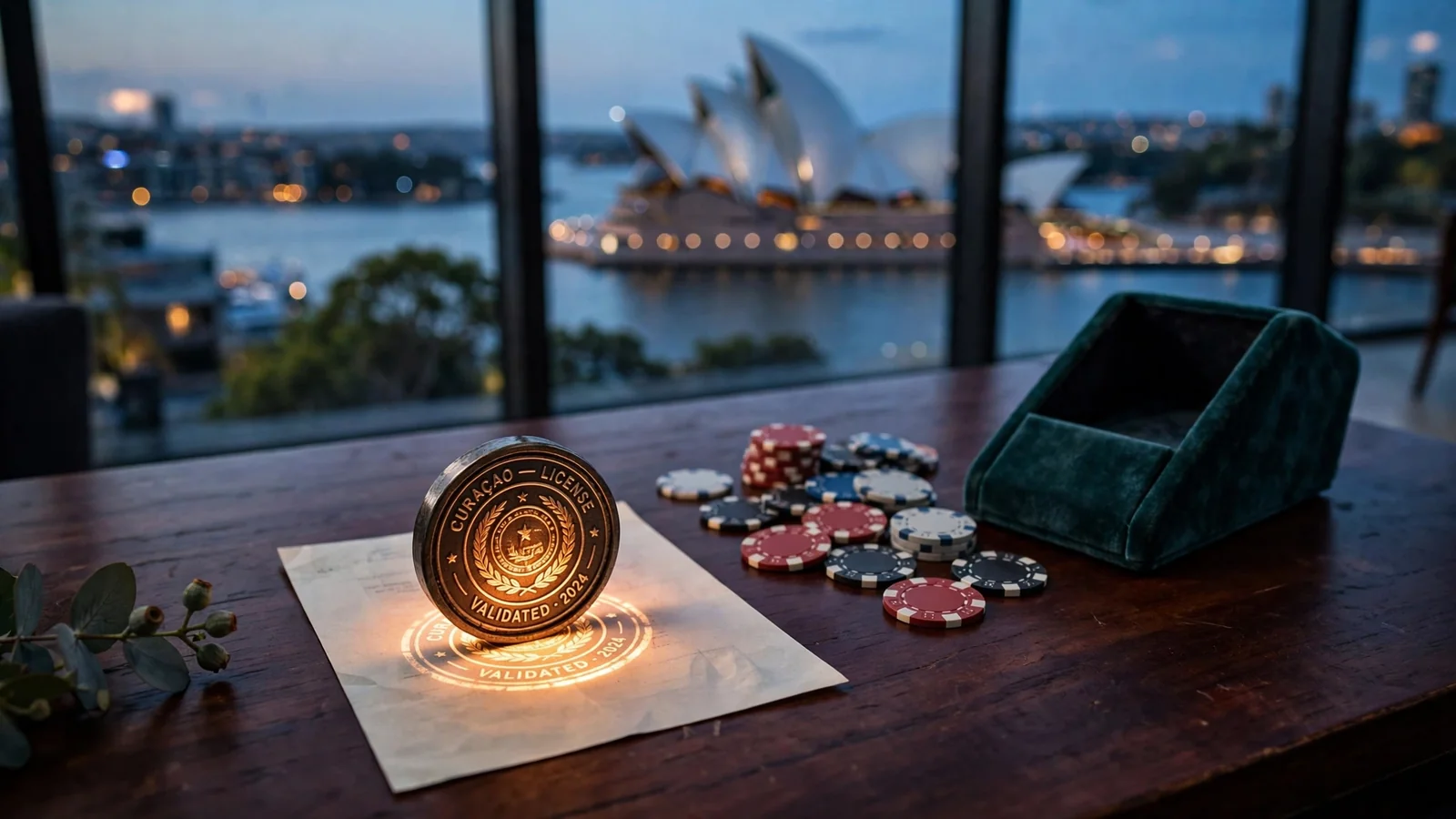
A casino may describe itself as licensed in Curaçao, but that statement does not establish that it is licensed in Australia. The two claims refer to different legal settings. An offshore licence concerns the authority a service says it holds elsewhere; Australian authorisation concerns whether that service may offer gambling to people in Australia under Australian law. One does not follow from the other.
That distinction can get blurred by the word “licensed”. In advertising, it can sound like a general seal of approval: a suggestion that the operator is permitted to serve customers wherever its website can be opened. In practice, a licence is tied to the jurisdiction and activity it covers. It is not a passport that automatically carries permission across borders.
So a Curaçao casino licence, even where a site makes that claim, cannot be treated as an Australian licence. It does not change the rules applying to services offered to people in Australia, and it does not give a site an exemption from those rules. The place named in a licensing claim and the place where a customer is located are separate parts of the issue.
A Curaçao casino licence is not an Australian licence and does not provide an exemption from Australian rules.
That is the point that matters when the phrase “Curaçao casino” appears beside assurances about legality. The phrase identifies an offshore connection; it does not answer whether the service is authorised here. Nor does a licence badge, a number displayed in a footer or a statement that an operator is “regulated” settle the Australian question by itself. Those details may describe what the operator claims about its status elsewhere. They are not an Australian authorisation.
I have seen how this language works commercially. A licensing statement is often placed near other trust signals, so the overall impression feels broader than the actual claim. “Internationally licensed” sounds expansive. What it establishes depends on the licence and the law behind it, not on the confidence of the wording. Neat badge. Narrow meaning.
For Australian customers, the relevant distinction is not whether an offshore casino has a formal relationship with a regulator somewhere. It is whether the service holds a valid Australian licence for the gambling product in question. ACMA has urged people to use its website and the national register to understand which gambling products are legal in Australia. Its public register is also the place Australians are encouraged to consult when checking whether a wagering service holds a valid Australian licence.
 $1 Minimum Deposit Pokies in Australia: What to KnowLearn why a $1 cashier minimum may not work with every payment route, and how operator limits differ from payment-method and processor…
 $10 Minimum Deposit Casinos in Australia: Payment RulesLearn why a $10 floor may depend on the payment method. One review puts usable Australian deposit minimums at $10–$20 AUD, not…
That register has a different role from an offshore licence claim. It concerns Australian licensing status, rather than confirming a site’s description of its position overseas. If a service’s name appears on a foreign-facing page, that should not be read as equivalent to appearing in Australia’s public licensing information. The categories should remain separate.
This is also why wording such as “available to Australians” can mislead. A website may be technically reachable, or may accept details from Australian users, but access is not the same as permission to offer a service. A foreign licence claim does not itself settle whether the operator is entitled to serve the local market. Nor does an account opening, payment option or customer support exchange turn an offshore status into Australian authorisation.
The distinction matters even when a site presents its licence as evidence of safety or legitimacy. A licence claim may be relevant to understanding what the operator says about its overseas status, but it cannot be used as a substitute for the Australian legal category. Combining those ideas in one sentence—“licensed offshore, therefore legal for Australians”—is the leap to avoid.
A virtual private network does not alter that licensing position. It cannot convert an offshore licence into an Australian authorisation. Using one to access a casino may also lead to voided winnings, account closure or loss of a deposit under the service’s terms. That is a separate practical risk, not a way around the legal distinction.
ACMA’s public register is the relevant Australian reference point for checking wagering licences and legal gambling products.
The clean reading is straightforward: “Curaçao-licensed” and “licensed in Australia” are not interchangeable descriptions. The first is an offshore claim; the second concerns Australian permission. ACMA’s public register is the relevant Australian reference point for checking wagering licences and legal gambling products. A foreign licence, however it is presented, cannot answer that local question on its own.
A licence badge is a claim made by the website displaying it. A number beside the badge may look more substantial, but it is still only a lead to verify. In checks I have handled, the useful question was never simply whether a site showed a licence. It was whether an official record supported the specific claim being made, for the business and service in front of the customer.
Start with the Australian record. ACMA’s public register is the place to check whether a wagering service holds a valid Australian licence. Search for the operator’s legal name, not just the brand on the homepage, and make sure the record relates to the service being assessed. A similar name is not a match. Nor is a licence held by a company with no clear connection to the website.
That check has a defined scope. A Curaçao licence claim and an Australian licence claim are not interchangeable, so a badge naming Curaçao does not answer the question of whether a service appears on the Australian register. The register is the relevant reference for the Australian claim. If the service cannot be matched to a valid record there, a badge or number on its own cannot fill the gap.
 $5 Minimum Deposit Pokies in Australia: Payment LimitsLearn why casino account limits may not match payment-method floors; one review reports usable Australian minimums of $10–$20 AUD.
 $20 Minimum Deposit Casinos in AustraliaLearn why a casino’s stated minimum may differ from a payment method’s own floor, and how bonus terms and transaction costs affect…
A polished seal, a regulator’s name, or a licence number can be copied into a webpage. Presentation is not verification. I treat the visible badge as a pointer, then compare the details it supplies with records published by the named regulator through its official channels. Avoid relying on a link embedded in the casino site as the only route: it may lead to a page controlled by the operator rather than an independent record.
The details need to line up. Check the licence holder’s name, the regulator identified, the status shown in the official record, and whether the record covers the brand or service being promoted. A record for a different company does not establish that the casino’s operator is covered. A valid-looking number attached to an unrelated entity is still a mismatch.
The domain matters too. The website name can differ from the company name, but there should be a clear, verifiable connection between them. If the official record does not identify the brand or domain, the operator should be able to explain the relationship in a way that can itself be checked. A support reply or a copied certificate may help identify what to look for; neither replaces the regulator’s record.
Offshore licensing language is often broad: “licensed”, “regulated”, or “approved” can appear beside a seal without making clear which authority issued it or which company holds it. Read the exact wording. A claim about a Curaçao licence should be checked against the official records of the authority the site names. Separately, any claim that the service is licensed in Australia should be checked against ACMA’s public register.
This distinction prevents a common verification error: finding a real licence record and treating it as proof of every other claim on the page. A record can support only what it actually identifies. It does not, by itself, confirm that another regulator has authorised the same service, that the domain belongs to the named holder, or that the badge has not been reused out of context.
I also keep a note of what was checked and when. Online records and website claims can change; a screenshot preserves what the casino displayed, not whether the regulator’s record was current. When a result is unclear, use the regulator’s official contact or guidance rather than relying on a casino representative to interpret the record. Independent confirmation matters.
If the operator name, domain, licence number, regulator, or status does not match the official record, the claim remains unverified. The same applies when no corresponding record can be found or the site gives no usable identifying details. Do not treat a badge as a substitute for the missing link. Do not proceed on the assumption that a plausible-looking certificate settles it.
This is not a technicality. Licensing statements are designed to reassure, and the small print can leave the customer doing the work of connecting a brand, a company and a regulator. In practice, each link has to hold. If it does not, the safe conclusion is not that the paperwork is probably fine; it is that the claim has not been established. Walk away from the claim.
ACMA’s public register provides a concrete starting point for checking an Australian licence. It does not turn an offshore badge into an Australian record, and a casino’s own page cannot certify itself. The discipline is simple: identify the exact claim, locate the relevant official record, and confirm that the names and service correspond. If they do not, stop there.
A comparison can put casino services side by side. It can summarise what each site says about its games, payment options, terms or licensing, provided those details are recorded accurately and kept current. That is useful as an organising tool. It is not a finding that any service is suitable or authorised for Australian customers.
The distinction matters because a polished table can make unlike things appear equivalent. A Curaçao casino list may place several sites in the same column, but a shared label does not establish that their terms, operating arrangements or standing in Australia are the same. Nor does a neat layout turn an offshore service into one licensed in Australia. Presentation is not permission.
I have seen comparison work treated as if the ranking itself carried authority. It does not. “Best” is an editorial judgement, and the criteria behind it decide what that judgement means. A score based on a welcome offer, for instance, would answer a different question from one based on clear terms or regulatory status. Without a stated and relevant method, a ranking is mostly a sales arrangement in table form.
A comparison can also leave important distinctions hidden. A site may describe a licence, while a table records only a badge or a short label. That is a description of the site’s claim, not an independent conclusion about what the claim permits in Australia. The wording in a comparison should make that difference visible rather than compressing it into a reassuring tick.
For Australian status, the relevant reference point is ACMA, the primary regulator of online gambling in Australia. Its public register is intended to help Australians establish whether a wagering service holds a valid Australian licence. A comparison page cannot replace that register or create an Australian licence by listing a service beside one. Different functions. Different weight.
The same caution applies to labels such as “trusted”, “safe” or “top-rated”. Those words may describe a reviewer’s assessment, a site’s own marketing, or a narrow feature of the product. They do not, by themselves, establish regulatory standing or consumer protection. In the industry, a prominent badge often does more work on the page than it does in the underlying legal position.
That does not make comparisons useless. A careful comparison can show which details have been disclosed, where terms differ, and which claims are being presented by the operator rather than independently established. It can also make omissions easier to notice. What it cannot do is settle the legal question through layout, star ratings or editorial confidence.
The operator list displayed alongside this discussion serves a separate editorial function. Its presence should not be read as an endorsement, or as evidence that an offshore casino is licensed in Australia. The comparison and the Australian authorisation question remain separate. That boundary is the point.
Online slots and casino games such as blackjack are illegal in Australia when offered to people in the country. The game’s name, presentation or software does not change that status. A digital slot remains an online casino game; blackjack does not become something else because it is dealt through a screen.
That point can get blurred by the language used around offshore services. A site may describe its product as “gaming” or present a catalogue of familiar casino titles, but those labels do not make online casino games legally available in Australia. Nor does the appearance of a game on a website establish that Australians may lawfully be offered it.
The distinction is about the service being provided, not whether a particular round looks like a physical casino game. Online slots and casino games are prohibited under the Australian framework. An offshore operator’s description of its catalogue cannot create an exception to that position.
I have seen product language do a lot of quiet work in this industry. “Entertainment” sounds broader and softer than gambling; “games” can make a casino catalogue feel ordinary. But the label is not the legal test. The activity still matters. Plainly put.
This is why searches for Curaçao-based gaming sites can lead to a misleading impression: a site may be visible online and may list slots or table games, yet that visibility does not mean those games are legally available to Australians. The relevant Australian status is unchanged by the country associated with the operator or by the wording used to market its games.
Prohibited Games
Online slots and casino games, including blackjack, are prohibited under the Australian framework regardless of the operator's location.
The same applies to game formats. A slot presented with a theme, or blackjack offered through a digital interface, remains within the category of online casino games. The prohibition is not limited to one style of slot or one version of a table game. The issue is their provision online to people in Australia.
For a practical reading of a casino site, promotional language should therefore be separated from legal availability. A prominent game lobby tells what the service presents; it does not establish that the service may offer those games in Australia. The legal position is direct: online slots and casino games, including blackjack, are prohibited here.
“Safe” can describe a narrow technical feature, not the whole relationship between a casino and its customers. A site may use SSL encryption to protect information sent during a transaction. It may also require identity checks before processing a withdrawal, asking for photo identification, proof of address and evidence that the payment method belongs to the account holder. Those measures can help secure data and verify identity. They do not establish that the service is authorised in Australia or that an Australian remedy is available if a dispute arises.
That distinction is easy to blur in promotional language. “Secure” may refer to the connection between a browser and a website; it says nothing by itself about whether winnings will be paid, how a complaint will be handled or which consumer protections apply. In my experience, a visible security feature is often treated as shorthand for trust. It is not.
Unlicensed gambling services lack Australian consumer protections. If a service withholds winnings, Australian laws may not assist in recovering them. A site’s own complaint process is not equivalent to protections that depend on the service being authorised under Australian law. Technical checks matter, but they cannot fill that gap.
ACMA can ask internet service providers to block access to websites offering prohibited interactive gambling services to Australians, as well as unlicensed services to adults in Australia. It can also issue fines to operators that breach the Interactive Gambling Act 2001. Blocking orders are available as a last resort when ACMA considers customer safety to be at risk. A site being accessible at one moment is therefore not evidence that it is approved or protected for Australian customers.
A VPN does not solve that problem. Using one to access a casino may lead to winnings being voided, an account being closed and deposits being lost. It can also make it harder to establish what location or account details the operator relied on. A technical workaround is not consumer protection.
The practical test is not whether an offshore site displays security language or a Curaçao association. It is whether Australian protections apply to the service. A reassuring badge cannot answer that. Neither can encryption.
A casino that accepts cryptocurrency may look different at the cashier, but the payment method does not establish whether the service is licensed in Australia. Crypto is a way to move value; it is not an Australian authorisation. I have seen payment options given prominent space in a site’s presentation because they make the account journey appear straightforward. That says nothing about the operator’s standing under Australian law.
Technical safeguards like SSL encryption and KYC identity checks concern data security and ownership, not Australian licensing status.
The same distinction applies to claims about a Curaçao-licensed crypto casino. An offshore licence and a crypto cashier are separate features, and neither one, alone or together, shows that the casino is authorised to provide online gambling services in Australia. A polished payment page can make a service look settled and professional. Appearance is not permission.
Security statements have limits too. Casinos use SSL encryption to help protect transactions and sensitive information while it is being transmitted. That is a technical safeguard, not evidence of licensing, and it does not resolve what happens if a dispute arises. “Secure” describes a narrow part of the process. It does not answer the legal question.
Identity checks are another part of the process that can be mistaken for reassurance. Casinos conduct KYC checks and may require identity verification before allowing a withdrawal. The documents commonly requested include photo identification, proof of address and proof that the payment method belongs to the account holder. Those checks concern identity and payment ownership; they do not turn an offshore service into one licensed in Australia.
Crypto does not remove the need for those checks. Nor should the presence of a coin logo be taken as a promise about withdrawal handling, protection or dispute resolution. Those matters depend on the operator’s terms and practices, while the currency itself cannot supply Australian consumer safeguards. I would separate the cashier’s convenience from the operator’s legal status every time.
Using a VPN to access a casino can create further risk: winnings may be voided, the account may be closed, and deposits may be lost. A change in apparent location does not create Australian authorisation. That is the point often obscured by a long list of payment symbols.
For Australian customers, the practical question is not whether a casino accepts crypto, but whether it is authorised to offer gambling services in Australia. Payment technology cannot answer that. Neither can encryption, identity checks or an offshore licence presented beside the cashier.
The year in the search does not change the test. A Curaçao licence, where a service claims to hold one, is an offshore licence; it does not by itself show that the service is authorised to offer online casino games in Australia. Nor does the date in the page title establish that Australian rules or a particular licence have changed.
The Australian framework draws its line around the service offered to people in the country. Under the Interactive Gambling Act 2001, domestic operators cannot offer online casino games to Australian residents. A licence issued offshore does not turn that prohibited offer into an Australian-authorised one. The central point for 2026 is therefore not whether a site displays a current-looking badge, but whether the relevant service holds Australian authorisation.
I have seen how a year in a headline can make a familiar claim sound newly confirmed. “For Australian players” may describe the audience a site hopes to reach; it is not proof of permission under Australian law. Likewise, a licence number or a statement that a licence remains active offshore answers a different question from whether the service is licensed in Australia. Two separate checks. Two separate meanings.
ACMA’s public register is the reference Australians are encouraged to use to check whether a wagering service has a valid Australian licence. That check should not be replaced by a casino’s own description of its offshore status. The register is about Australian licensing, not a shortcut for treating an offshore credential as local approval.
So the answer for 2026 is precise: the year does not grant an exception. An offshore licence alone cannot establish Australian authorisation, and the relevant question remains whether the service is licensed in Australia. No calendar-year wording changes that distinction.
A newly visible offshore casino can become inaccessible to Australians without changing its own branding or website address. ACMA can ask internet service providers to block access to services it identifies as prohibited or unlicensed for adults in Australia. A site that appears in a listing today may therefore be blocked later, or may stop serving the Australian market itself.
The scale is not theoretical. Since ACMA made its first blocking request in November 2019, it has restricted access to 1,369 illegal gambling and affiliate websites. That figure covers a broad group of sites, not just casinos, and it does not mean that every new Curaçao-branded service will be blocked. It does show that Australian access is subject to ongoing enforcement rather than being settled by a site’s launch or visibility.
There is another route out: operators can leave voluntarily. Around 220 illegal services have exited the Australian market since stricter online gambling rules were enforced in 2017. From the operator’s side, maintaining access can become commercially unattractive when enforcement, compliance risk and customer access are uncertain. A withdrawal may be abrupt from a customer’s perspective, even if the business decision has been developing behind the scenes.
I have seen how “new” works in online gambling: it describes a fresh offer or a newly noticed brand, not a stable commitment to serve a particular country. A page can remain online while access from Australia is blocked, or a service can stop accepting local customers. Neither outcome is proof that the operator has been authorised here.
Using a VPN to get around a block is not a reliable workaround. It may breach the site’s terms and can lead to winnings being voided, an account being closed, or a deposit being lost. The practical point is simple: offshore availability can change. No permanence implied.
A question about whether Curaçao has casinos can mean two different things. It may refer to physical venues on the island, or to websites that offer casino-style games and carry a Curaçao connection. Those are separate subjects. A result about an online operator does not establish anything about local venues, and a reference to a venue does not prove that an online service is licensed or available to Australians.
I have seen these categories blur in casino copy. A place name can be used to suggest local presence, regulatory standing or a connection to a particular market, even when the page is discussing only an online service. The wording may sound specific; the underlying claim may not be. The distinction matters.
Under the Interactive Gambling Act 2001, domestic operators cannot provide those games to Australian residents. That rule concerns online services and does not answer whether physical casinos exist in Curaçao. Nor does a webpage about a venue settle the status of an online casino.
So the phrase “casinos in Curaçao” needs context before it can be understood. Is the material describing a place to visit, an internet-based gambling service, or a company’s licensing claim? Those are not interchangeable descriptions. A search result may place them side by side, but proximity on a page is not evidence that one establishes the other.
I would keep the claims separate: a statement about physical venues belongs to a question about Curaçao itself; a statement about online gambling for Australians belongs to the Australian framework. One does not answer the other. No inference should be drawn from the name alone.
The Interactive Gambling Act 2001 does not explicitly criminalise individual players for using offshore casino sites. However, that does not authorise the service: Australian law prohibits domestic operators from offering online casino games to residents, and ACMA can take enforcement action against operators.
Licensed operators provide deposit limits that can be set daily, weekly or monthly. Reputable platforms also offer information about gambling-related harm and direct players to professional support services in Australia.
You may be asked for photo ID, proof of address and proof that you own the payment method used. Identity checks are commonly required before withdrawals.
PayID transfers and some e-wallet withdrawals can be quick after approval; PayID may clear within minutes once released. Bank transfers and card withdrawals can take several business days, and card withdrawals may be slower or unavailable.
Methods mentioned include PayID, e-wallets, bank transfers and cards. POLi is mainly for deposits, so do not assume it can be used for withdrawals.