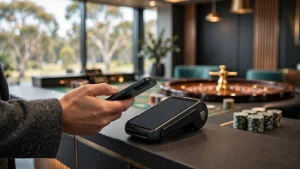
A careful look at what casino payment claims establish—and what remains unconfirmed about PayID deposits, withdrawals and offers.

“Accepts PayID” sounds like a simple yes-or-no label. In practice, it needs a precise meaning before it can be useful. A payment option displayed somewhere on a site is not, by itself, proof that PayID is available to Australian customers, works for casino transactions, or is supported by the operator at the time a transaction is attempted.
I treat acceptance as a claim about a specific service, a specific payment method and a specific customer context. The operator would need to identify PayID as an available method for Australian customers, and the claim would need to apply to the casino service rather than to another product or part of the business. Without those boundaries, “PayID accepted” can describe little more than a logo or a broad statement about payment options.
That distinction matters because payment labels can be loose. A site might mention a bank-linked service in general, while the cashier presents a different set of methods. A payment provider might be available in one country but not another. A method might appear on an information page yet not be offered for the transaction in question. Those possibilities are not proof that any particular operator behaves this way; they show why a bare acceptance label needs a defined scope.
When looking for casinos that accept PayID in Australia, payment availability and processing details are worth checking before you deposit. The notes below highlight the specific information available for each operator without assuming that a listed licence confirms PayID support.
Neospin
Neospin is listed with a Curaçao Gaming Control Board licence, OGL/2023/176/0095, held by Hollycorn N.V. No PayID details are provided here.
Ricky Casino
Ricky Casino lists PayID payouts at 1–3 business days and crypto payouts under 1 hour. Its minimum deposit is A$20, or A$30 to qualify for the bonus.
7Bit Casino
7Bit Casino is operated by Dama N.V. and is listed as licensed in Curaçao. No PayID details are provided here.
Rollero Casino
Rollero Casino is listed with a Curaçao Gaming Control Board licence, OGL/2023/176/0095, held by Hollycorn N.V. No PayID details are provided here.
Lucky Dreams
Lucky Dreams has a stated minimum deposit of A$20 via POLi and is listed as licensed in Curaçao. PayID availability is not specified.
LevelUp Casino
LevelUp Casino is listed with a Curaçao eGaming licence, OGL/2023/174/0082, held by Dama N.V. Its stated minimum deposit is A$15; no PayID details are provided here.
DragonSlots Casino
DragonSlots Casino is listed as licensed by the Curaçao Gaming Authority, with Jumpman Gaming Ltd named as the operator. No PayID details are provided here.
House of Pokies
House of Pokies lists PayID payouts at 1–24 hours and a minimum deposit of A$30, with PayID deposits from A$10. Its source describes the licence as international but does not name the jurisdiction.
Roby Casino
Roby Casino is listed as holding a Curaçao eGaming licence, with Roby Games Ltd named as the licensee. No PayID details are provided here.
JustCasino
JustCasino is listed as licensed by the Curaçao Gaming Control Board. No PayID details are provided here.
The name also needs to refer to PayID itself, not simply to a transfer that happens to involve a bank account. Similar descriptions can conceal different payment rails, conditions or responsibilities. If the method is not clearly identified, a reader cannot tell whether “PayID” is being used accurately or as shorthand for a wider category of bank payments.
There is a second distinction between a service being technically available and being a reliable, authorised option for a particular customer. A payment method can be presented by a business without that presentation establishing the legal status of the underlying service. In Australia, the Interactive Gambling Act 2001 prohibits operators from providing real-money online casino games to people located in the country. The payment label does not change that boundary. Australian consumer law also does not protect people using offshore casinos.
The phrase “Australian casino” can blur these issues. It may mean a business based in Australia, a site aimed at Australians, a service available from an Australian internet connection, or simply a page written for an Australian audience. Those meanings are not interchangeable. Nor does an Australian-facing payment option establish that an operator is permitted to provide online casino games to people in Australia.
I have seen how payment language is often made to carry more weight than it can bear. “Local,” for instance, may sound like an assurance about the operator, when it could refer only to a payment route or currency. “Instant” may describe one stage of a transaction and leave out everything around it. The wording earns its value only when it identifies exactly what is being offered and to whom.
 Payments & Crypto for Australian CasinosThis page brings together Australian casino searches for cards, bank payments, e-wallets and cryptocurrencies, rather than game or bonus topics.
 Tether USDT at Australian Online Casinos: What to VerifyLearn how to assess USDT support at online casinos, and why payment claims need evidence rather than being inferred from games, bonuses…
A sound definition of PayID acceptance would therefore need to answer a narrow question: does the operator explicitly offer PayID for casino transactions to Australian customers, rather than merely mentioning PayID somewhere on its site? A separate claim would be needed to establish whether the method applies to deposits, withdrawals, or both. These are distinct functions; naming a method does not automatically settle which one it supports.
The same discipline applies to claims about a mobile casino. A site being accessible on a phone says nothing about which payment methods it supports. “Mobile” describes the device or interface, not the payment arrangement. Combining the terms can make a claim feel more specific without adding useful detail.
This is where rankings create a particular problem. Words such as “best” suggest comparison, and comparison requires more than a payment label: it implies that the listed services have been assessed against a common standard. Without substantiated PayID acceptance for the operators being compared, a ranking would give the impression of a useful distinction while resting on an unproven premise.
For me, the essential test is semantic before it is promotional. “Accepts PayID” should mean that the operator clearly identifies PayID as a method available for the relevant casino transaction and customer location. It should not be inferred from a bank-transfer reference, a mobile-friendly page, an Australian audience, or a general payment logo. Even a correctly described payment option cannot make an otherwise prohibited service lawful.
A label is not confirmation.
A site comparison can look precise while resting on a weak claim. A table may label a payment method as “accepted”, then attach a rating or a “best” badge. Those labels are only useful if they can be tied to a current, identifiable operator policy. Without that connection, the table records an assertion, not a dependable comparison.
I would not rank casino sites for PayID on the basis of a bare claim. Ranking implies that the entries have been checked against the same standard and that the differences between them mean something. If acceptance has not been established, a score cannot repair the gap. It merely gives uncertainty the appearance of measurement.
A useful claim should make clear which operator it concerns, what payment method is being described, and where the information comes from. It should also be possible to tell whether the statement reflects the operator’s own published terms or a third party’s summary. These are not decorative details. They determine whether the claim can be checked and whether it still applies.
“PayID supported” is too compressed to settle those questions by itself. A page might use the label in a heading, a comparison cell, or promotional copy without showing the basis for it. Repetition across pages does not strengthen the evidence if each page traces back to the same unsupported statement. Several copies are still one claim.
The wording matters, too. “Available” can sound definitive, while a nearby qualification may narrow the statement or make it conditional. A comparison that lifts only the headline and omits the qualification presents a different picture from the underlying terms. I have seen that kind of compression turn a cautious description into an apparent promise. Small wording. Big consequence.
Calling a site the best adds a second judgement on top of the acceptance claim. It suggests that the method is confirmed and that some meaningful comparison has been made. Neither follows simply from a page mentioning PayID.
A sound ranking would need a consistent basis for comparison. If one entry is included because of a brief promotional phrase and another because of a detailed operator statement, they are not being assessed on equal terms. If the underlying information cannot be checked, a ranking also cannot distinguish confirmed support from copied or outdated wording.
The same caution applies to a list of sites said to accept PayID deposits. A list format can imply that each entry has passed a shared check, even when the page does not explain what that check was. The number of entries is not evidence. Nor is a polished layout.
For that reason, I would not present a “best PayID casino” or a ranked set of sites as a finding. It would turn a claim that has not been substantiated into a recommendation. Leaving names out is more accurate than assigning them a position they have not earned.
A useful claim must identify the operator, the specific payment method, and the source of the information to be verifiable.
The most useful distinction is between a statement and its support. A statement says that a site accepts PayID. Support shows who says so, where the terms can be found, and whether the wording actually refers to the payment method in question. If those pieces are absent, the claim should remain unconfirmed rather than being upgraded by confident design.
A comparison page can still be read for what it is: a pointer to a claim that would need independent confirmation. Its badges, ordering, and summary language should not be treated as proof. An operator’s own current information would carry more weight than an unattributed comparison, but even then the scope of the statement matters. A page may be general, conditional, or no longer current; the label alone does not resolve that.
I also separate payment wording from other measures of quality. A site might receive a favourable overall rating for reasons unrelated to PayID. That rating cannot establish payment support. Conversely, a payment claim does not establish that the site is suitable, reliable, or lawful for a particular person. One point cannot stand in for another.
This is why a responsible comparison cannot identify the best casino sites accepting PayID from unsubstantiated labels. It can explain the standard a claim would have to meet, but it should not fill the gap with operator names, rankings, or a confident verdict. No ranking is the honest result.
A casino deposit by PayID sounds like a narrow payment question: whether a deposit can be made using that service. The wording can conceal several separate claims. A site might display a payment logo, describe a method in general terms, or state that a particular transaction is available to customers in Australia. Those claims are not interchangeable. For a deposit specifically, the relevant point is whether PayID is actually offered for that transaction and under what conditions.
That is not a minor omission. Those details determine whether a payment method is usable, not merely whether its name appears in promotional copy.
I have seen payment descriptions treated as if they were operational facts. They are not. “PayID accepted” may sound definite, but without a stated deposit route and applicable terms it leaves the practical question unanswered. A payment option could be limited by account status, location, the cashier’s available methods or other operator conditions.
The same distinction applies to timing. A deposit described as available does not establish when funds would appear in an account. Payment networks and operator-side handling are separate parts of a transaction. One cannot be used to infer the other.
A deposit fee is equally specific. The same applies to minimums, maximums and any account restrictions. Such terms can matter more than the payment label, but they cannot be supplied by borrowing conditions from another method.
That last point matters in particular with cards. A specialist review may describe an Amex deposit process, but that process says nothing about PayID. Card details, card issuer decisions and card-specific fees belong to a different payment route. Transferring those details would make a PayID deposit description inaccurate. Different method. Different mechanics.
The expression “PayID deposit” therefore has to be read narrowly: it should mean a deposit option that is explicitly available through PayID, rather than a general reference to bank-linked payments or to online transfers. Even then, the wording alone does not establish the applicable steps or terms. A casino with a PayID deposit would need to identify the method as available for deposits and explain the conditions governing it. Without that, the claim remains incomplete.
There is also a broader boundary around the search. Australian law prohibits operators from offering real-money online casino games to people in Australia. A payment label does not alter that restriction or establish that an offshore service is lawful or protected. Australian consumer law does not protect players using offshore casinos. That is a material risk, not a footnote to the payment method.
PayID can be part of a search for an online casino, but payment language does not change the legal position of the service being considered. Under the Interactive Gambling Act 2001, operators must not provide real-money online casino games to people in Australia. That prohibition covers casino-style play, regardless of whether a site describes itself as offshore or lists a particular payment method.
The distinction in the law matters. The Act places the relevant prohibition on operators; it does not explicitly make an individual player’s use of an offshore casino a criminal offence. That is not the same as saying an offshore service is lawful to provide in Australia, or that using one comes with the protections available in a regulated local market. A search result can blur those points by presenting an operator as available to Australians without explaining the legal boundary.
I have seen how wording can do that work. “Accepts Australian players” sounds like a straightforward service claim. It does not establish that the operator is permitted to offer online casino games here, nor does a payment option settle the question. A cashier page describes a transaction feature; it does not grant legal status. Different issues. Different rules.
The Australian Communications and Media Authority, or ACMA, is responsible for enforcing the Interactive Gambling Act. Its role is relevant because the restriction is not merely a private term between a player and a website. The law concerns the provision of prohibited interactive gambling services to people in Australia, and ACMA is the regulator responsible for enforcement.
That framework is easy to lose sight of when a page is organised around a method such as PayID. Payment descriptions often make an operator seem like an ordinary merchant: choose a method, enter details, continue. But the existence of a familiar payment label cannot establish whether the underlying gambling service may legally be offered in Australia. Nor does it show that an operator’s claims about access amount to regulatory approval.
The player-side distinction should also be read carefully. The fact that the Act does not explicitly criminalise an individual for using an offshore site does not turn the activity into a protected consumer transaction. Australian consumer law does not protect players who use offshore casinos. If a dispute arises over account access, funds or a site’s conduct, the absence of those protections is a practical risk, not a technical footnote.
Legal Risk
Under the Interactive Gambling Act 2001, operators are prohibited from providing real-money online casino games to people in Australia, and consumer law does not protect players using offshore casinos.
I would separate three questions that promotional wording tends to compress: whether a payment method is mentioned, whether a site says it accepts people in Australia, and whether the operator is legally allowed to provide online casino games here. An answer to one does not answer the others. A payment name is not a licence, and a site’s own description is not a regulator’s decision.
So searches for Australian PayID casinos sit within a legal context that payment comparisons cannot resolve. The central boundary is the operator’s prohibition under the Interactive Gambling Act 2001, with ACMA responsible for enforcement. The absence of an explicit player offence does not erase that boundary or restore Australian consumer-law protection for offshore casino use.
A payment label and a game catalogue answer different questions. PayID describes a way to move money; it does not identify what a gambling service offers, establish that the service accepts that payment method, or show that the payment can be used for a particular game. Treating those points as interchangeable turns a narrow payment claim into several claims that need separate evidence.
I have seen how a cashier can make a method look more definitive than it is. A logo or a line of text may indicate a payment option, but it does not, by itself, establish the conditions attached to it or how it relates to the rest of a site. The reverse is also true: a page describing games says nothing reliable about which payment methods are supported. Two separate systems. Two separate claims.
That distinction matters when a phrase such as “PayID casino games” appears. It can sound as if a named set of games is available through PayID, when the wording may only combine a payment term with a casino category. Without reliable details about both the payment arrangement and the service, the phrase does not prove either point. Nor does it show that individual games have a distinct PayID payment route.
The same caution applies to broad labels such as “PayID payment options.” A label does not explain whether it refers to deposits, withdrawals, or another transaction, and it does not establish that the method works for every part of a service. Those are operational distinctions, not fine print that can be safely inferred from a heading.
There is also a separate Australian boundary. The Interactive Gambling Act 2001 prohibits operators from providing real-money online casino games to people in Australia, and the Australian Communications and Media Authority enforces that law. A payment reference cannot change the legal status of the service it is attached to. The payment method is not a licence, approval, or indication that a service may lawfully be provided to Australian residents.
For the same reason, a game-related claim should not be treated as a recommendation or as confirmation that a service is available to Australian players. Australian consumer law does not protect people using offshore casinos. That is a material limit, not a footnote.
I would keep the wording precise: a claim about PayID is a claim about payment support; a claim about games is a claim about the service’s content. Neither verifies the other. Where those statements are blended together, the useful information disappears. The label does not bridge the gap.
Australian payment habits can make a new payment option sound more established than it is. Contactless credit and debit cards are accepted across almost all of the country, and mobile wallets such as Google Pay and Apple Pay are similarly widespread. Consumers are also comfortable moving between cards, mobile wallets and bank-linked services such as PayPal.
That describes everyday familiarity with different ways to pay. It does not show that a particular online service accepts PayID, or that PayID is available for any casino-related transaction. I have seen this distinction get blurred in payment copy: a method is familiar in Australia, so the wording quietly suggests it must also be supported by a particular operator. Familiarity is not an integration.
A payment method has to be enabled by the business accepting the payment, and the relevant terms depend on that service. A person’s ability to use contactless cards in shops, or to switch between a wallet and a bank-linked service, does not establish that a casino has connected to PayID. Nor does the general popularity of digital payments establish how a payment would be handled by an individual site.
That is the gap behind phrases such as “Australian PayID casino” or “casino with PayID”. They may sound like straightforward descriptions, but they combine two separate ideas: a payment option used in Australia and a service that may or may not support it. Without operator-specific confirmation, the phrase cannot do the work of proof.
The same caution applies when a site displays familiar payment brands. A logo or a broad statement about payment flexibility is not the same as confirmation that PayID is supported. The distinction matters because payment copy often compresses several steps into one reassuring label. “Easy” may describe a familiar interface; it does not establish which payment rails are available.
In practical terms, Australian comfort with switching between payment types explains why people may expect a range of options. It does not establish that all, or any particular, casino accepts PayID. General habits are context, not evidence of an operator’s payment setup.
A familiar payment culture. Nothing more.
A PayID withdrawal means more than seeing PayID mentioned alongside a casino’s payment options. A payout must actually be offered through that method, and the operator must explain how it works. Without those details, neither availability nor a processing time can be established.
Payment methods are not interchangeable. A method shown for adding funds does not, by itself, show that winnings can be returned through the same route. Nor does the word “instant” settle the question: it may refer to one part of a transaction, while approval, account checks or a bank’s handling can affect when money is accessible. Those distinctions matter, but no PayID-specific withdrawal route or timing can be stated.
I have seen payment language do a lot of work while leaving the operational detail unclear. The useful distinction is between a method being named and a complete payout process being described. A credible description would need to say whether PayID is available for withdrawals, what account details are involved, whether conditions apply, and how timing is measured. Without that, “PayID withdrawals” is a label, not a confirmed service.
Attention: A method shown for adding funds does not automatically mean winnings can be returned through the same route.
Identity checks can also sit between a withdrawal request and its completion. Online casinos commonly require customers to complete a Know Your Customer assessment before financial transactions. That general requirement does not tell anything specific about PayID, or establish when a particular payout would be processed.
The Australian context cannot be set aside when interpreting such claims. The Interactive Gambling Act 2001 prohibits operators from providing real-money online casino games to people in Australia, and the Australian Communications and Media Authority enforces the Act. A payment description does not change that legal position.
So an Australian-facing claim about a PayID casino payout should not be read as proof of a working withdrawal option or an instant result. The key details would have to be explicit and specific to PayID; a deposit reference, a general promise about speed, or a payment logo cannot fill in the missing mechanics. No confirmed route. No confirmed timing.
A request for a real-money casino that accepts PayID combines two separate issues: whether an operator provides a payment route and whether it may lawfully offer casino games to people in Australia. A payment label cannot answer the legal question. Nor does the phrase “real money” establish that a service is available or authorised for Australian residents.
The Interactive Gambling Act 2001 places the restriction on operators. It makes offering online casino games to people in Australia unlawful; it does not expressly make an individual player’s use of an offshore site a criminal offence. That distinction matters, but it is not a consumer safeguard. Australian consumer law does not protect people who use offshore casinos.
From the operational side, a payment method can appear in a cashier without telling the whole story. A deposit option would not, by itself, show that withdrawals use the same route, that a service is lawful for Australians, or that a promotion is available. Payment wording is not proof.
The same caution applies to requests for a casino that accepts PayID debit. That wording does not establish how a transaction would be classified, whether a debit route exists, or whether the operator can offer the underlying gambling service to someone in Australia. Those are separate matters, not interchangeable descriptions of one feature.
This is where “real money” can sound more conclusive than it is. It describes the intended transaction, not the legal status of the operator or the protections attached to the service. An offshore site may be reachable, but Australian consumer law does not provide protection for players using it. Reachability is not approval. PayID is not a legal status.
I have seen payment claims treated as if they settle every question around a casino account. They do not. A payment route, even if accurately described by an operator, cannot establish a lawful offer to Australian residents or supply consumer protections that do not apply to offshore play. No shortcut.
PayID is a payment label, not proof that a casino can receive or return money through it. A site may mention bank-linked payments without naming PayID, while a general payment logo does not establish that this specific method is supported. I have learned to separate the name of a payment service from the transaction a cashier actually permits. They are not interchangeable.
For a casino payment method to be meaningfully described as PayID, the operator would need to identify it in the cashier and set out the relevant conditions. Those conditions can include which account details are used, whether the method is available to Australian customers, and how the operator handles a transaction. Without those particulars, describing a casino as one that accepts PayID would turn an assumption into a claim.
The same distinction applies to searches for a casino to pay with PayID. A reference to bank services, or to a familiar Australian payment habit, does not establish casino acceptance. Nor does it show that PayID is available for every customer or every transaction. Payment options can be specific to an operator and may be presented differently across its pages.
I would not treat a payment badge, a broad statement about deposits, or a third-party description as enough on its own. The useful evidence is a clear, current cashier entry supported by terms that explain how the method works. If the information is vague or conflicts across pages, the label is not a reliable basis for deciding how a payment can be made.
“Pay by PayID” sounds definitive. The mechanics matter.
There is also a separate Australian context: the Interactive Gambling Act 2001 prohibits operators from providing real-money online casino games to people in Australia, and the Australian Communications and Media Authority enforces the law. Australian consumer law does not protect players using offshore casinos. A payment label does not change either point.
So the phrase “PayID casino payment method” should be read narrowly: it describes a claim about payment support, not proof that a particular casino accepts PayID or that a transaction will succeed. I would keep that distinction clear rather than infer acceptance from general payment language.
A casino bonus described alongside PayID can create the impression that the payment method unlocks a particular offer. That connection needs to be stated in the offer’s terms; the two labels appearing together do not establish it. I have seen how promotional wording can compress separate ideas into one headline. “PayID bonus” may sound like a defined benefit, while the actual wording may leave unclear whether the payment method matters at all.
A bonus associated with PayID could mean several different things in ordinary language: an offer for customers who pay by PayID, a general casino promotion shown near a PayID option, or simply a page using both terms. Those meanings are not interchangeable. Without explicit conditions, it would be a mistake to treat the phrase as proof of eligibility, a cash value, or a particular way to claim an offer.
The same caution applies to a no-deposit bonus. That label does not, by itself, explain who qualifies, what actions are required, or whether PayID has any role. I will not fill those gaps with standard-sounding rules: promotional terms are not universal, and guessing can turn a headline into a false promise.
In Australia, the legal context is not a footnote to a casino promotion. The Interactive Gambling Act 2001 prohibits operators from offering real-money online casino games to people in Australia, and the Australian Communications and Media Authority enforces that law. Australian consumer law does not protect players who use offshore casinos. A bonus headline does not change either point.
The practical distinction is simple: a payment method and a promotion are separate claims unless clear terms connect them. For a PayID casino bonus, the wording would need to specify that relationship rather than rely on proximity or an appealing label. Without that clarity, the offer cannot be treated as a defined PayID benefit. No assumption.
Limits are set by each casino and can vary. Check the casino’s cashier and payment terms for its current Amex deposit and withdrawal limits.
Check the casino’s cashier for American Express as a deposit option. Jackpot City Casino, Spin Palace, Ruby Fortune, Ignition Casino, Joe Fortune and PlayAmo are identified as supporting Amex deposits for Australian players.
Amex casino deposits are processed instantly. Withdrawals can take up to five days to clear.
Look for American Express in the casino’s cashier and confirm it is offered for deposits to Australian players. Some casinos do not accept Amex, and a bank or Amex may also block a particular transaction.
Amex casino deposits are processed instantly.
Yes. Each casino sets its own Amex deposit and withdrawal limits, so check the limits shown by that operator. Amex transaction limits are usually higher than those for Mastercard and Visa.