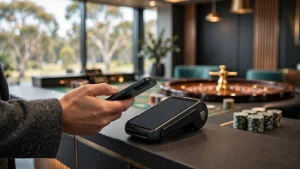
Bitcoin casino payments depend on blockchain confirmations and operator crediting rules, while Australian legal boundaries and bonus terms need separate checks.

Bitcoin changes the route a payment takes, not the basic distinction between money being sent and money being available in a casino account. In a conventional online payment, a provider may notify the site that a transaction has been authorised. With Bitcoin, the transfer is broadcast to the blockchain, where it can be observed before it has accumulated the confirmations a casino requires for crediting. That gap is where many payment-status misunderstandings begin.
The flow has several separate stages: a transfer is initiated, the Bitcoin network records it, the transaction gains confirmations, and the casino’s payment system updates the account balance. These are related events, but they are not identical. A transaction showing as pending in a wallet or on a blockchain explorer does not, by itself, mean the casino has made the funds playable. The operator’s system has to recognise the payment and apply its own crediting rule.
A specialist review describes offshore Bitcoin deposits as being credited after blockchain confirmations. That gives a useful picture of the mechanism, but it should not be mistaken for a universal service promise. The confirmation threshold and the way a site displays payment status can differ. I have found it more useful to read “sent”, “detected” and “credited” as separate labels, rather than treating them as synonyms.
A Bitcoin transaction can be visible to the network before it is included in a block. A confirmation indicates that inclusion; further confirmations build on that record. A specialist review puts one confirmation at 10–60 minutes, depending on congestion and the fee paid, and describes casinos as requiring 1–3 confirmations before crediting. Those figures are a snapshot from that type of source, not a fixed clock for every transaction or casino.
The practical point is that confirmation time belongs to the network, while account crediting also depends on the casino’s payment controls. A transaction may be visible but still awaiting the site’s required status. Congestion can make the network stage less predictable, and a casino may take additional time to recognise a payment after the relevant confirmations appear. The balance shown in the account is the point at which the funds have been credited there, not merely the point at which a wallet reports that they have left.
This distinction matters when a game session is planned around an expected balance. Some specialist reviews describe instant-play options that allow a session to begin once a deposit is detected, before full confirmation. Detection is not the same as completed settlement: a provisional balance or early access feature may still depend on the transaction reaching the required state. A site’s wording should make clear what happens if a detected transfer is delayed or does not receive the expected confirmations.
There is a trade-off behind early access. It can reduce waiting at the start of a session, but it does not make the underlying Bitcoin transfer final sooner. The interface can move ahead of the network record; it cannot rewrite it. That is why a payment status and an available balance should be checked independently.
A crypto wallet manages Bitcoin transactions; the casino account records the balance the site recognises for play. Specialist reviews describe payments as moving directly from a crypto wallet, with transactions recorded on the blockchain for verification. The public record can show transaction details, but it does not reveal a player’s full identity simply by displaying a transaction. Nor does the public record show whether the casino has credited an account: that status sits in the operator’s own system.
A crypto wallet manages Bitcoin transactions, whereas the casino account records the balance recognized by the site for play. The public blockchain records the transaction but does not show if the casino has credited the account.
The casino may display a Bitcoin-denominated balance or convert the value into another display currency. Those figures can serve different purposes. The amount of BTC transferred is a quantity of cryptocurrency; its fiat value can change while the transaction is pending or while funds remain in an account. Bitcoin’s price volatility can therefore affect the value represented by a deposit or winnings, even when the BTC amount itself has not changed.
A payment method also does not remove ordinary account checks. Identity verification documents must be provided before withdrawals can be processed. That is separate from blockchain confirmation: one establishes the status of a transaction on the network, while the other concerns the casino’s account and withdrawal process.
The same basic payment logic applies whether a casino interface is opened on a desktop or a mobile device. The screen may make a pending transaction look immediate, but the blockchain and the casino’s crediting rules still determine when the balance is recognised. A polished interface is not a confirmation.
Bitcoin transfers are irreversible once completed on the network. A mistaken destination or incompatible network can lead to permanent loss, and there is no card-style chargeback built into the transaction. The payment rail is traceable; recovery is another matter.
For Australian players looking for casinos that accept Bitcoin in 2026, checking the available payment and licensing information can help narrow the options. Use this list as a starting point and verify current terms before signing up.
Neospin
Neospin is listed with a Curaçao Gaming Control Board licence, OGL/2023/176/0095, held by Hollycorn N.V.
Ricky Casino
Ricky Casino lists crypto payouts in under an hour and PayID payouts in 1–3 business days. The minimum deposit is A$20, or A$30 to qualify for the bonus.
7Bit Casino
7Bit Casino is listed as Curaçao-licensed and operated by Dama N.V.
Rollero Casino
Rollero Casino is listed with a Curaçao Gaming Control Board licence, OGL/2023/176/0095, held by Hollycorn N.V.
Lucky Dreams
Lucky Dreams is listed with a Curaçao licence. Its minimum deposit via POLi is A$20.
LevelUp Casino
LevelUp Casino is listed with a Curaçao eGaming licence, OGL/2023/174/0082, held by Dama N.V. Its minimum deposit is A$15.
DragonSlots Casino
DragonSlots Casino is listed under the Curaçao Gaming Authority, with Jumpman Gaming Ltd named as the operator.
House of Pokies
House of Pokies lists PayID payouts in 1–24 hours and a minimum deposit of A$30, with PayID deposits from A$10. Its source describes the licence as an international iGaming licence but does not name the jurisdiction.
Roby Casino
Roby Casino is listed with a Curaçao eGaming licence, with Roby Games Ltd named as the licensee.
JustCasino
JustCasino is listed as licensed by the Curaçao Gaming Control Board.
“Best” is not a useful verdict until the comparison says what it is measuring. A site can support Bitcoin yet be inaccessible from Australia; another may accept deposits but not offer Bitcoin withdrawals. A polished cashier does not resolve either problem. I separate practical access, payment terms and the reliability of the information being compared. None of those points turns an offshore casino into an Australian-licensed service.
Availability is not the same as suitability. A site appearing online, or loading from an Australian connection, does not establish that it can lawfully offer casino games to people in Australia. The Interactive Gambling Act 2001 prohibits operators from providing online casino-style games to Australian residents, and Australia does not issue a domestic licence for those games. ACMA focuses on blocking unlicensed offshore gambling sites; it has banned operators from Australia and blocked their sites. Access can therefore change, and a page that opens today is not proof of stable access or regulatory approval.
This is why “best Bitcoin casino Australia” should not be read as a promise that a listed site is available, authorised or protected under Australia’s casino framework. A comparison can describe what a site says it supports, but that is different from endorsing the service. I treat availability as a condition to verify, not a feature to celebrate. Do not use a VPN to get around a block: bypassing restrictions can breach a platform’s terms and put an account or funds at risk.
Payment support needs two directions. The label “Bitcoin accepted” may describe deposits only. A meaningful comparison checks whether the same currency can also be selected for withdrawals, whether the casino’s stated network matches the wallet transaction, and whether fees or conversion rules are disclosed before funds are moved. A mismatch can make a transfer difficult or impossible to recover. Crypto transactions are irreversible, so a mistaken address or network can mean permanent loss.
The cashier is only part of the picture. Account verification may be required before a withdrawal is processed; identity documents should not come as a surprise at that stage. Crypto prices can also move between deposit and withdrawal, changing the value of a balance when measured in Australian dollars. Those risks do not disappear because the transaction is recorded on a blockchain, and crypto does not provide greater consumer protection than ordinary gambling payments.
Irreversible Transactions
Crypto transactions are irreversible; a mistaken address or incompatible network can result in the permanent loss of funds.
I also distinguish a payment feature from a promotional headline. “Best Bitcoin casino bonus” and “best Bitcoin casino bonuses” are not meaningful comparisons unless the full terms are visible: wagering rules, game exclusions, maximum cashout conditions and excluded payment methods can change whether a promotion is usable. That belongs in a separate review of the offer, not in a payment-method label. A bonus banner is not a cash equivalent.
The same discipline applies to claims about games or a “latest” site. A catalogue description does not establish that a game is available to Australian residents, and a new-looking interface does not establish trustworthiness. The phrase “best Bitcoin casino games” can blur two questions—what is listed and whether the service may offer it in Australia. Those should not be treated as one.
For a Bitcoin casino list, the useful details are therefore factual and conditional: what payment options are stated, whether withdrawal support is also stated, what account checks apply, and whether access is affected by blocking. A ranking cannot substitute for those checks. If a site is inaccessible, or its payment conditions are unclear, that is material—not a minor drawback to be softened by a high score.
Self-exclusion also requires attention. People registered with BetStop or a state-based self-exclusion program must self-exclude directly with each offshore platform; registration in an Australian scheme should not be assumed to cover offshore sites. In the end, “best” is a label, not a safeguard. Read the conditions. Check access independently. Do not confuse availability with approval.
A Bitcoin cashier and a live dealer table answer different questions. The cashier describes how value moves; the table describes the service being offered. In my experience, promotional copy often puts these things side by side until they seem like one package. They are not. A cryptocurrency payment method does not change the legal status of the game.
That distinction matters most with live casino-style play. A streamed blackjack or roulette table may look different from a digital game because a person deals the cards or spins the wheel on camera. But the Interactive Gambling Act 2001 explicitly prohibits operators from providing online casino-style games, including blackjack and roulette, to people in Australia. The live presentation does not turn those games into a different category for this purpose.
The same boundary applies to other online casino games named in the Act, including poker and slots. Whether a site accepts Bitcoin, another cryptocurrency or a different payment method does not remove that boundary. Payment branding is not a licence, and a Bitcoin balance does not make a casino service lawful to provide in Australia.
Labels such as “live dealer” describe how a game is presented, not whether the operator is authorised to offer it to people in Australia. Likewise, a site advertising itself as a Bitcoin casino is describing a payment feature. Neither label establishes that the games may legally be offered here.
Attention: The Interactive Gambling Act 2001 prohibits operators from providing online casino-style games to Australian residents, regardless of the payment method used.
Australia does not issue a domestic licence for online casino games. The Interactive Gambling Act bars operators from offering those games to Australian residents under an Australian licence. So there is no Australian online casino licence that makes a live casino table acceptable simply because the operator lists Bitcoin among its payment options.
This is the point that can get lost when a page leads with a polished studio, a dealer on camera or a prominent crypto symbol. Those details may explain the product’s appearance or its payment route. They do not answer the regulatory question. Separate the sales language from the service itself.
A “best” label does not resolve it either. A ranking of live tables or Bitcoin payment features is not evidence that the underlying service is permitted in Australia. Nor does a site’s own description settle the question. The legal boundary concerns the operator providing the game to people in Australia, not the currency shown in the cashier.
Bitcoin is not named in the Interactive Gambling Act 2001. That does not mean a casino game becomes exempt when transactions use cryptocurrency. The relevant distinction is between the method of payment and the activity being offered. A live blackjack game remains an online casino-style game whether a player’s account is funded with Bitcoin or another method.
I have seen the payment feature treated as if it were the main product. It is easier to explain, easier to advertise and visually simple: a coin logo beside a deposit option. The legal character of the service sits elsewhere, in what the operator makes available. That is the part worth examining first.
The distinction also prevents a common misunderstanding about live dealers. A human dealer may make the experience feel closer to a physical casino, but the game is still being provided online. The camera feed does not create an Australian domestic licence, and the use of crypto does not supply one.
For Australian readers, the practical takeaway is narrow but important: a Bitcoin option tells something about payment, not permission. Live casino-style games sit within the online casino category addressed by the Act, including where the table is streamed and the wager is placed through a website. Different wrapper. Same boundary.
No payment label changes that.
A headline such as “Bitcoin bonus” identifies a payment theme, not the rules governing a promotion. The same applies to claims about free Bitcoin Pokies, a no-deposit offer or a deposit bonus. The useful detail sits in the terms: which games count, what must be wagered, whether a cashout cap applies and whether Bitcoin is an eligible payment method.
I have seen bonus copy do its job in a few words, then leave the qualifications to the terms page. “Free” may mean bonus credit rather than withdrawable Bitcoin. “No deposit” describes how the offer is triggered; it does not establish that winnings can be withdrawn without conditions. A deposit promotion may require an eligible deposit, and paying with Bitcoin does not by itself make that payment eligible.
The mechanics are in the conditions.
Wagering requirements describe how much qualifying play is required before bonus funds or related winnings can be withdrawn. The terms should say what balance the requirement applies to and which activity counts. Without those definitions, a headline cannot show the actual withdrawal condition. A promotion can look generous while being difficult to use if much of the play does not qualify.
Game restrictions matter just as much. Terms may distinguish pokies from other casino games, or exclude particular games and features. A promotion described as a Bitcoin slots bonus does not prove that every Bitcoin video slot contributes equally—or contributes at all. The specific game rules, not the banner wording, determine how the offer operates.
A maximum cashout is a separate limit on the amount that can be withdrawn from a bonus or its winnings. It can matter even after wagering conditions have been met. The terms need to make clear whether the cap applies to bonus winnings, the bonus balance or another defined amount. Those distinctions are easy to miss when the headline is the only part being read.
Payment exclusions can change the offer’s value. A promotion may exclude cryptocurrency deposits, or set conditions that differ by payment method. That means a Bitcoin deposit bonus cannot be assumed to apply merely because a site accepts Bitcoin. The terms should identify eligible methods and explain what happens if a deposit is made through an excluded one.
None of these labels changes the Australian legal position. Under the Interactive Gambling Act 2001, operators are prohibited from providing real-money online casino games, including slots, to people in Australia. A bonus does not make such an offer lawful, and cryptocurrency does not create an Australian casino licence. The restriction is directed at the operator; it does not make an Australian player’s participation a criminal offence.
There is also a practical distinction between promotional balance and funds that can be withdrawn. Casino terms may require identity documents before a withdrawal is processed, and bonus conditions can remain relevant at that stage. Crypto prices can move while a balance is held, so a displayed Bitcoin amount may not retain the same value in Australian dollars.
For people registered with BetStop or a state-based self-exclusion program, exclusion must also be applied directly at each offshore platform. A promotion’s availability does not override that responsibility. The label sells the possibility. The conditions—and the legal boundary—define what it means.
A casino that accepts Bitcoin is an online operator that permits deposits or withdrawals in BTC. That describes a payment option, not the operator’s legal status in Australia. A site can advertise itself as a Bitcoin casino, or support BTC alongside other payment methods, without holding any Australian authorisation.
The Interactive Gambling Act 2001 does not name Bitcoin or cryptocurrency. Its focus is the service being offered: the law makes it unlawful for operators to provide certain online casino services to people in Australia. Changing the payment rail from a bank transfer to Bitcoin does not change the nature of the gambling service. Payment method and legal permission are separate questions.
A foreign offshore licence is not an Australian licence and does not place a crypto casino within Australia's domestic regulatory framework.
That distinction matters when interpreting claims about an “offshore licence”. A foreign licence is not an Australian licence, and it does not place a crypto casino within Australia’s regulatory framework. Australia does not issue a domestic licence for online casino games. The law’s prohibition is directed at the entity offering the service; it does not make an Australian player criminally liable simply for playing at an offshore casino. Those are different legal positions, not two ways of describing the same risk.
So, when asking which casino sites accept Bitcoin, acceptance alone says little about protection or lawful availability. It confirms only that the operator says it can handle BTC. It does not establish that the site is authorised in Australia, that a foreign regulator can resolve a dispute for an Australian customer, or that the service can be accessed without restriction. ACMA has blocked offshore gambling sites, so a site’s presence in a search result is not proof that it remains accessible.
I have seen “crypto-friendly” used as though it were a trust mark. It is not. It tells something about payment support, not the quality of oversight. Nor does cryptocurrency make the transaction anonymous by default: the payment method does not erase the operator’s rules or identity checks. Before treating a Bitcoin casino as usable, the relevant questions are whether it accepts Australian customers, whether BTC is supported for both deposits and withdrawals, and what rules govern an account and any payout.
There is also a separate practical boundary for people who have self-excluded. Anyone registered with BetStop or a state-based self-exclusion program must also exclude themselves directly at each offshore platform; the local register does not automatically close offshore accounts.
The short version is exact: Bitcoin does not create a loophole in Australian gambling law. A casino may take BTC, while the service it offers remains outside Australia’s domestic licensing framework and subject to restrictions on operators. Payment acceptance is a feature—not a legal clearance.
An “instant play” label can describe when a casino interface lets a session begin, not when a Bitcoin deposit is fully settled. A specialist review describes some sites making play available once a deposit is detected on the blockchain, before the transaction has completed its confirmations. That is an operator’s early-credit decision, not a change to Bitcoin’s settlement process.
The distinction matters. A wallet or casino page may show a transaction as detected or pending while the casino’s account balance remains provisional, restricted, or subject to later adjustment. Detection means the transaction has appeared on the network; it does not, by itself, mean that every confirmation condition has been met. A specialist review reports that casino crediting requirements can be expressed as a range of one to three confirmations, but the applicable rule is site-specific and can change.
I would read “play now” as a timing feature with conditions attached. The games may open before the deposit is treated as complete, but that does not establish that the funds are final or that every function in the account is available. If the transaction remains unconfirmed, the displayed balance and the status of any activity may depend on the operator’s rules. The headline leaves that part unsaid.
There is also a legal boundary that a payment label cannot alter. Under Australia’s Interactive Gambling Act 2001, operators are prohibited from providing real-money online casino games, including pokies, to people in Australia. Australia does not issue a domestic licence for online casino games. An instant-play option or Bitcoin payment method does not make such an offer lawful for Australian residents.
That makes the first-session timing question different from a recommendation to start playing. For anyone assessing a site’s claims, the useful distinction is between “detected,” “credited” and “confirmed”: these are not necessarily the same status, and the operator’s terms determine what each one permits. A balance appearing quickly is not proof that a transfer has cleared.
A provably fair label, where a site uses one, concerns how game outcomes are presented or checked; it does not verify a deposit’s confirmation status or change the legal position in Australia. Nor does a quick route into Bitcoin pokies establish that an operator is authorised to offer them locally.
The cleanest reading is a cautious one: early access may be offered, but it can precede final confirmation and remain subject to the casino’s own handling of pending funds. Fast interface. Pending settlement.
The coin shown beside a casino’s cashier is not just a different label for the same payment. Each asset uses its own network, and the timing and cost of a transfer can change with network conditions. From the operator’s side, accepting a coin also means being able to credit deposits sent on that network and process withdrawals back through it. Support for one does not establish support for another.
 Casinos accepting Bitcoin Cash in Australia: key checksLearn how BCH payment claims, bonuses and withdrawals should be assessed, and why the Interactive Gambling Act 2001 focuses on operators rather…
 Casinos That Accept PayPal in Australia: What’s KnownLearn why familiar PayPal use does not confirm casino support, and why no verified shortlist or withdrawal processing times can be provided.
 EcoPayz for Australian Casino Sites: What to CheckLearn why an Australian-facing label or cashier logo does not confirm EcoPayz availability, transaction terms, or authorisation for online casino games.
A specialist review comparing crypto-casino payments reports that Bitcoin transfers may take longer to confirm than Litecoin or Ethereum transfers. That is a comparison, not a timetable: network activity and the fee attached to a transaction can affect how quickly it is confirmed. The time a casino takes to recognise a payment is a separate matter. A faster-moving network does not, by itself, guarantee that an account is credited sooner.
Litecoin is described in a specialist review as widely accepted across crypto casinos, with lower network fees than Bitcoin or Ethereum. That may make it an appealing payment option where the casino supports it for both deposits and withdrawals. But “widely accepted” is not the same as universally available. The cashier’s current list and withdrawal terms determine whether a particular coin can be used for the whole payment cycle.
Ethereum has a different cost trade-off. A specialist review notes that its transaction fees can exceed Bitcoin’s during busy periods. Fee levels are not fixed, so the comparison can shift as network demand changes. A casino’s own fees or processing rules may also affect the amount credited or returned; network fees alone do not describe the complete cost.
Familiar choice, but may have longer confirmation times and higher fees during peak periods.
Widely accepted with generally lower network fees than Bitcoin or Ethereum.
Transaction fees can exceed Bitcoin's during busy periods.
Bitcoin remains a familiar choice, but familiarity does not make it the cheapest or quickest option in every transaction. Nor does selecting a coin alter the underlying gambling service. It changes the payment rail, not the games or the protections attached to them.
There is also a currency risk that is easy to overlook when the cashier displays a balance in crypto. The value of a deposit or a later withdrawal in Australian dollars can move while the coins are held. A balance that appears unchanged in BTC, LTC or ETH may therefore represent a different Australian-dollar value when converted.
The practical comparison is specific: which coin is accepted, whether it is available for withdrawals as well as deposits, how its network behaves at the time, and what fees apply. A coin appearing in a deposit menu is not enough. Read the withdrawal conditions too. Small distinction; real consequence.
“Bitcoin casino” describes a payment option, not a legal category. An offshore site may accept Bitcoin, but using cryptocurrency does not bring that business within Australia’s regulatory framework or give it an Australian licence. Crypto casinos are not licensed in Australia and operate outside the country’s system of oversight.
The distinction matters because the Interactive Gambling Act 2001 focuses on the service being provided, not the currency used to pay for it. Its restrictions apply to operators offering prohibited online gambling services to people in Australia. Bitcoin does not change who is providing the service or where the player is located. A site’s use of “Australian Bitcoin casino” in its marketing is not proof that it is authorised to operate here.
The player-side position is different from the operator’s. There are no specific Australian laws prohibiting individuals from using offshore crypto gambling sites, and the prohibition is directed at the entity offering the service. That does not make an offshore casino locally regulated, nor does it create the protections associated with an Australian licence. Access may also be restricted: the Australian Communications and Media Authority blocks unlicensed offshore gambling sites. A blocked site is not a signal to bypass the restriction with a VPN; doing so may breach the platform’s terms and risk account closure or voided winnings.
I separate those questions when assessing the label: what payment method is supported, what service is being offered, and what oversight applies. They are not interchangeable. “Crypto” can make a payment feel detached from ordinary gambling rules, but the location and nature of the service remain relevant. No special legal status follows from a Bitcoin balance.
There are practical limits too. Offshore platforms may require identity documents before processing withdrawals, and cryptocurrency values can move between the time funds are deposited and when winnings are converted or spent. A change in Bitcoin’s price can affect the value of either. Cryptocurrency does not provide greater consumer protection simply because transactions use a blockchain.
Attention: Users registered with BetStop or state-based programs must self-exclude directly with each offshore platform, as local registers do not automatically apply.
Anyone registered with BetStop or a state-based self-exclusion program must also self-exclude directly with each offshore platform; the local register does not automatically apply there. That boundary is easy to miss. A crypto payment changes the rail, not the regulatory position.
A specialist review describes the basic direction of a Bitcoin deposit: funds move from a personal wallet to the casino’s designated address. A withdrawal goes the other way, to a wallet address entered for the payout. The wallet and casino account are separate; a transaction on the blockchain does not remove the need to follow the casino’s own payment instructions.
Before sending, compare the full destination address with the one displayed for the deposit. Bitcoin transfers are irreversible: an address error can mean permanent loss of the funds. The same applies to the network. The casino’s stated network must match the one selected in the wallet; choosing a different network can leave the transfer inaccessible.
I have seen payment instructions treated as a formality. They are not. Check that the casino supports Bitcoin withdrawals as well as deposits before transferring funds. An advertised deposit route alone does not establish that the same coin or network is available for cashing out.
Network fees are separate from the amount sent and can change with congestion. A specialist review reports Bitcoin fees reaching AUD 10–20 per transaction during peak periods; that is a reported peak, not a standing charge. Check the wallet’s fee estimate before approving a transfer. The value of Bitcoin can also move while funds are held, affecting the Australian-dollar value of a deposit or eventual winnings.
A casino may require identity documents before processing a withdrawal, so a wallet address is not the only requirement to settle in advance. Real-money online casino games are illegal for operators to provide to people in Australia; an offshore licence is not an Australian licence. Players enrolled in BetStop or a state self-exclusion scheme must also exclude directly at each offshore platform.
Small checks. Permanent transfers.
A withdrawal from Bitcoin pokies has two separate clocks: the casino’s internal review and the transfer across the Bitcoin network. Seeing a balance marked as “withdrawal requested” means the first stage has begun, not that a transaction has already been broadcast.
The casino may review the account and require identity documents before processing a payout. Only after it approves and sends the Bitcoin does blockchain confirmation become relevant. A specialist review reports casino-side processing taking 12–48 hours before a payout is sent; treat that as one source’s account, not a reliable timetable for every site. The same type of review says a withdrawal reached a personal wallet within an hour after casino processing. Network conditions and the operator’s own procedures can differ.
Once sent, a transaction can be checked on the blockchain, but a displayed transaction is not necessarily the same as funds being available in the wallet. The casino may also set its own confirmation requirements. The exact status labels and timing depend on the service.
The receiving address matters. Bitcoin transfers cannot simply be reversed if funds go to the wrong address, so a mistaken payout destination can mean permanent loss. Confirm that the casino supports Bitcoin withdrawals before depositing, and check the address carefully when requesting payment. Identity checks are not a substitute for that check.
There is also a value risk between play and cash-out: Bitcoin’s price can move, changing the Australian-dollar value of a balance or payout while it is held. A displayed BTC amount does not lock in its value in AUD.
Promotional language around “fast” payouts does not collapse these stages into one. The request, account review, broadcast and network confirmation are distinct events. Timing claims need a stated basis—and even then, they are not a guarantee.
Australian players are not specifically prohibited from using Bitcoin at offshore casinos. However, operators are prohibited from offering online casino games to Australian residents, and crypto casinos operate outside Australia’s regulatory framework.
The crypto payment methods covered here are Bitcoin, Litecoin and Ethereum. Availability varies between casinos, and Bitcoin network fees can rise during busy periods.
Yes. You can request a Bitcoin payout to your wallet, though casino processing may take 12–48 hours; after it is sent, it typically reaches your wallet within an hour.
Australian players are not themselves prohibited from playing at offshore online casinos, but operators are prohibited from offering online casino games to Australian residents. ACMA blocks unlicensed offshore gambling sites.
To deposit, send cryptocurrency from your wallet to the address provided by the casino; the balance is generally credited after the required blockchain confirmations. To withdraw, request a payout to your wallet address, and complete any identity checks required by the casino.