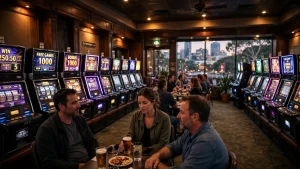
The guide distinguishes venue schedules from live availability and explains why payout, location and online-pokies claims need verification.
“Open now” sounds like a simple status, but it combines two different questions: whether a venue is scheduled to operate at that time, and whether its gaming area is actually available when someone arrives. Those are not the same thing. A venue’s general opening hours may not describe every part of its operation, and a listing that appears current is not necessarily a live update.
I have seen how easily a precise-looking time can acquire more authority than it deserves. Once it is repeated across directories or copied into a map listing, it can look confirmed even when nobody has checked whether it still applies. The wording may be confident. The information behind it may be old.
For anyone trying to establish whether pokies are available in Perth at a particular moment, the useful distinction is between a published schedule and a current confirmation from the venue. A schedule describes the hours a business says it intends to keep. It cannot, by itself, establish that the venue is operating as usual on a particular day, or that the gaming area is accessible at that moment. Temporary changes and operating conditions can matter. A static listing does not resolve them.
That matters especially for searches about early or late opening. A phrase such as “open early” can mean different things to different people; it is not a specific operating time. Even when a search result displays a time, that detail should be treated as a lead to check, not proof that pokies are available. The same caution applies to a result marked as open now. It may reflect a venue’s listed schedule rather than a live confirmation.
A more dependable check is one that comes directly from the venue and relates to the intended visit. A current notice on an official venue channel may clarify a temporary change; direct contact can resolve whether the relevant area is operating. If those channels do not give a clear answer, the status remains uncertain. That is less satisfying than a neat timetable, but it avoids turning a guess into a plan.
There is also a practical difference between a venue being open and its gaming facilities being open. A business can have other services or areas operating while the part associated with pokies is unavailable. An hours listing may refer to the premises as a whole and leave that distinction unstated. I would not read a general “open” label as confirmation of machine access unless the information makes that clear.
The wording on listings deserves attention, too. “Open” can describe ordinary business hours; “open now” can be generated from those hours; “hours may differ” signals that the schedule is not a guarantee. None of these phrases alone confirms conditions on arrival. A listing’s update date, if shown, can help judge how recently it was reviewed, but even a recent update is not the same as a live operating check.
The best answer to whether Perth pokies are open at a particular time is therefore not a city-wide yes or no. It depends on the individual venue and the current operating information available for it. Without a venue-specific, current confirmation, a broad claim about what is open would be unreliable. Naming a place or giving a time without that confirmation would make the answer look more certain than it is.
That same discipline applies to payout-percentage claims encountered alongside opening information. A venue’s hours and a machine’s stated return are separate matters; an opening listing cannot establish anything about how a pokie is configured or what an individual will receive. Mixing the two in one result does not make either claim stronger. One is about access at a particular time. The other concerns game mechanics.
For planning purposes, the distinction is straightforward: treat published hours as scheduled information, and live availability as something that requires current confirmation. If the venue’s own information is unclear, the honest answer is that its present status has not been established—not that it is definitely open or definitely closed. No guesswork dressed as a timetable.
Choosing pokies for Perth in 2026 means weighing what is known about each casino, including its stated licensing and any available payment details. Use these notes as a starting point and check the current terms before signing up.
Neospin
Neospin is listed with a Curacao Gaming Control Board licence, OGL/2023/176/0095, held by Hollycorn N.V.
Ricky Casino
Ricky Casino lists crypto payouts in under an hour and PayID payouts in 1–3 business days. The minimum deposit is A$20, or A$30 to qualify for the bonus.
7Bit Casino
7Bit Casino is operated by Dama N.V. and lists Curacao as its licensing jurisdiction.
Rollero Casino
Rollero Casino is listed with a Curacao Gaming Control Board licence, OGL/2023/176/0095, held by Hollycorn N.V.
Lucky Dreams
Lucky Dreams lists a Curacao licence and a minimum deposit of A$20 when depositing with POLi.
LevelUp Casino
LevelUp Casino is operated by Dama N.V. and lists a Curacao eGaming licence, OGL/2023/174/0082. Its minimum deposit is A$15.
DragonSlots Casino
DragonSlots Casino is listed as licensed by the Curacao Gaming Authority, with Jumpman Gaming Ltd as operator.
House of Pokies
House of Pokies lists an international iGaming licence, though the jurisdiction is not named. PayID payouts are listed at 1–24 hours; the minimum deposit is A$30, or A$10 when using PayID.
Roby Casino
Roby Casino is operated by Roby Games Ltd and lists a Curacao eGaming licence.
JustCasino
JustCasino lists a Curacao Gaming Control Board licence.
“Best-paying” sounds like a ranking, but a stated return cannot tell a Perth player what the next session will produce. A return figure describes a game setting, not a promise attached to an individual spin. It cannot identify which machine will pay during a visit, or establish that one player will come away ahead.
A specialist review reports that some game providers let casinos choose between different return-to-player settings for the same pokie. That matters when comparing a title by name alone: the version available at one casino may not use the same setting as the version elsewhere. A figure attached to a game therefore needs context. Without knowing the setting used at a particular venue, the game’s name is not enough to establish its return there.
Even a confirmed setting would not predict a particular result. Pokie outcomes are generated through a Random Number Generator, and each spin is treated as a separate event. A previous win does not make another win due; a run of losses does not make a payout more likely on the next spin. The machine has no memory of a player’s sequence in the sense needed to balance it out during that session.
Attention: A stated return figure describes a game setting, not a promise of a payout for an individual session or spin.
That is the distinction advertising can blur. “High return” may sound like a practical promise, but it refers to a theoretical measure over play, not a forecast for a person standing at a machine. The figure does not say when a payout will occur, how large it will be, or whether a session will recover its cost. A short session can depart sharply from the long-run expectation.
I have seen the wording do quiet work: a percentage is placed beside a game title, and the reader supplies the missing certainty. The number looks precise, so it can feel like evidence of a likely result. It is not. It is useful only when the setting is known and its meaning is understood; it does not turn chance into a schedule.
That also limits claims about the “best” pokies in Perth. A title cannot be ranked as best-paying for every casino or every player merely because a return figure appears somewhere. The setting may differ between casinos, and the individual result remains uncertain even when the setting is confirmed. Without comparable, venue-specific settings, a Perth-wide ranking would imply more than the numbers establish.
The same caution applies to talk about casino pokies in the CBD or across the city. Location does not resolve the return-setting question. Nor does a game’s popularity establish how it will perform for an individual. A familiar title can still be configured differently elsewhere, while two people playing the same setting can have very different sessions.
For online searches, the term “pokies” can refer to a different way of playing, but the core point about the game’s return is unchanged: a stated setting is not a personal forecast. It should not be read as assurance of a payout, and it cannot identify a reliable way to win. A number is not a timetable.
In practical terms, “best-paying” can only be a qualified comparison when the return setting is known and the comparison is like for like. It cannot honestly mean “the machine most likely to pay this player now.” That claim would require certainty the mechanics do not provide.
No guaranteed winner.
A venue’s reputation, the number of machines it has and the way it handles gambling-related incidents are different measures. They are often bundled together in claims about the “best” pokies venue, but one does not prove the others. From the counter side, the paperwork matters: it can show what a venue is required to record or staff, not whether its machines offer a better return or whether one Perth venue outperforms another.
A report published by regionriverina.com.au describes a requirement for venues with more than 20 gaming machines to have a dedicated responsible gambling officer (RGO) on duty while those machines are operating. The report also describes a one-month grace period for venues to remove signage and introduce the officer role. These details should be read as reported requirements, not treated as a confirmed rule applying to every Perth venue. A regional report cannot, by itself, establish the conditions at an individual venue in Western Australia.
The same report says venues will be required to keep a gambling incident register. The register is intended to record occurrences, including situations where a patron’s behaviour suggests they may be at risk of, or affected by, gambling harm. That is an oversight measure: it creates a record of events and supports a venue’s response. It is not a scorecard for machine quality, payout performance or customer experience.
That distinction is easy to lose in promotional language. “Responsible” may describe a process or a staff role; it does not certify a venue as safer in every respect, and it says nothing about the odds of a particular pokie. An incident record is also not a public league table. Without comparable venue-level information, there is no sound basis for using it to rank Perth venues.
The same limit applies to claims about machine numbers or performance. A city-wide comparison would need reliable, like-for-like figures for the venues being compared. A general reporting requirement supplies no such figures. It cannot establish which Perth venue has the most machines, which has a particular game, or which one pays more. I would not turn an administrative rule into a recommendation. Different question.
For anyone weighing up Perth pokies venues, the practical point is to separate what a venue oversight rule can tell from what it cannot. It can describe duties around staffing and recording incidents where those duties apply. It cannot tell a player what a machine will return, predict a session’s result or establish a “best” venue. A responsible gambling officer is a support and compliance role, not a signal that a venue has better-paying machines.
Nor does the existence of a register show how many incidents occurred at any particular Perth venue. That would require venue-specific records and a basis for comparing them, neither of which follows from the general description of the requirement. No responsible comparison can be built from a rule alone.
A responsible gambling officer (RGO) is a support and compliance role, not an indicator that a venue has better-paying machines.
So the careful answer to requests for the best pokies venue in Perth is not a ranked list dressed up as certainty. Oversight requirements matter, but they answer a narrower question: what procedures venues are expected to follow. They do not supply a Perth-wide machine comparison. A clean distinction.
A venue described as “near Perth Airport” can sound straightforward, but the label does not tell the whole story. It might refer to a place within an airport precinct, somewhere in a surrounding area, or simply a result a mapping service considers relevant to the airport. Those are different claims. Without a confirmed venue address, there is no sound basis for saying that pokies are available inside the airport or naming a nearby venue.
I have seen location copy turn a broad search match into a confident-sounding recommendation. The wording may be neat; the underlying distance may not be. A map result can establish where a listed business appears to be, but not whether it has pokies, whether those machines are accessible to the public, or whether the listing is current. A pin is not proof of a gaming floor.
The same care applies to the Perth CBD. “Central Perth” and “near the CBD” are flexible descriptions, not fixed boundaries. A search result could fall within a central area, on its edge, or in a neighbouring district. Calling somewhere “near” the CBD without a checked address and a clear basis for the claim leaves the most important detail unresolved: near by what measure—straight-line distance, a practical route, or a short walk?
That distinction matters when comparing results. A venue can look close on a map but be inconvenient to reach by the route actually available. Travel conditions can also change, so a location description should not quietly imply a particular journey time. I would treat “near” as a starting point for checking, not as a usable measurement.
North Perth and other nearby area names create another layer of ambiguity. A result associated with an area may be outside the place a reader has in mind, or may use a broad locality label. The search wording alone cannot confirm the venue’s exact position or whether it offers pokies. Location and machine availability are separate facts; one cannot stand in for the other.
For airport-related searches, the key distinction is between a venue at the airport and a venue somewhere around it. For CBD-related searches, it is the difference between a central address and a loose claim of proximity. In both cases, a reliable description needs a confirmed address and a specific, understandable basis for calling the place nearby. Without those, directions, distances and venue names would add confidence without adding evidence.
I would also separate location claims from current operating information. An address does not establish that a venue is open, and a map listing does not confirm that pokies are operating there. Those are separate checks, not details that can be inferred from a location label.
So the careful answer to searches for pokies near Perth Airport, in central Perth or in North Perth is not a guessed list. It is to distinguish the place being searched from the broader area a result may represent, then verify both the venue and its machines before relying on the description. Search wording can point to an area. It cannot do the checking.
A request for information about pokies at Crown Perth can sound specific while leaving the important details unanswered. The venue name does not establish which machines are available, how its gaming floor is arranged, or whether any particular game can be found there. Those details need current, venue-specific confirmation; they cannot be inferred from the name alone.
I separate three things that are often bundled together in casual descriptions: the existence of a venue, the machines it offers, and the conditions attached to those machines. Knowing the first does not establish the other two. A description that calls a room “best” may be expressing a preference, summarising an individual visit or repeating promotional language. Without a defined basis for comparison, it does not show that one room offers better conditions or outcomes than another.
The same caution applies to lists of games. A title appearing in a general catalogue, an old post or a player’s account would not, by itself, establish that it is currently on Crown Perth’s floor. Nor would a game’s presence tell anyone what settings apply to a particular machine there. Specific claims need evidence tied to the venue and the time they are meant to describe.
Payout language needs even more care. “Maximum cash payout” can sound like a single property of a venue, but the phrase may refer to different things: a machine’s prize limit, a particular game’s top prize, or the amount that can be paid in one transaction. These are not interchangeable. Without a confirmed definition and a current source, attaching a maximum to Crown Perth would create precision without support.
This is where polished wording can do more work than the evidence. “Top room” sounds like a ranking; “big payout” sounds like a dependable feature. Neither label explains what was measured, when it was checked or whether the claim applies to every machine. I would not treat those phrases as a practical comparison unless the underlying terms are clear. Attractive wording is not a specification.
Even a confirmed machine list would answer only a limited question. It would identify games, not establish that a particular player will win, or that one venue offers a better outcome. A venue-specific claim should therefore be kept to what its evidence actually shows: machine availability, if documented, is not a promise about performance.
For Crown Perth, the responsible line is narrow. The name can identify the venue being discussed, but it cannot substantiate claims about its current floor, particular pokies, a “best” room or a maximum cash payout. Those details should not be filled in from generic casino descriptions or assumptions about what a large venue might offer. Specificity has to be earned.
Searches for online pokies around Perth often combine several separate issues: whether an operator may offer real-money games in Australia, whether a player faces a penalty, and whether deposited money can be recovered. Those are not the same question.
The Interactive Gambling Act 2001 prohibits companies from providing real-money online casino games, including pokies, to people in Australia without a domestic licence. No Australian online-casino licences have been issued. There is therefore no Australian-licensed online casino for real-money pokies.
The law is directed at operators, not individual players. A person is not made criminally liable simply for playing on an offshore site that accepts Australian customers. That distinction does not make the service lawful for the operator, or turn an offshore account into a locally protected one. The Australian Communications and Media Authority blocks access to illegal offshore gambling sites, and internet providers must comply with its blocklist. Access may be interrupted.
The practical risk is clearest when something goes wrong with money. If an offshore casino refuses to pay winnings, an Australian player has no legal recourse in Australia to compel payment. A deposit method is not a safeguard against that outcome. Nor does a payment option show that a site is licensed, that its games are fair, or that its terms will be honoured.
That matters when an offer is framed as “no deposit” or as an easy way to start playing. The label says little about the conditions attached to an account or any eventual withdrawal. Before any first withdrawal, identity and address documents should be verified; an operator’s document requirements and handling of personal information are part of the risk, not a minor administrative detail. A balance shown on a screen is not the same as money that can be recovered through Australian channels.
PayID also needs to be understood narrowly. It is an alias layer on the New Payments Platform, allowing transfers through an email address, mobile number or ABN; using it for a real-money deposit requires linking it to a bank account. The payment rail does not confer a gambling licence. A specialist review has described PayID as being treated like other qualifying deposit methods at the sites it covers, but that is a statement about that review’s coverage, not an assurance about every operator or a measure of legal protection.
The same caution applies to searches for high-limit play, maximum bets or the “best-paying” option in Perth. A deposit route, a large advertised limit or a bonus does not establish that an online casino is authorised to serve Australians. Those commercial terms cannot remove the central problem: the operator is offering a prohibited service, and local remedies are absent if a dispute arises.
BetStop is not a workaround for that gap. It applies to Australian-licensed operators and does not bind offshore sites. The distinction is important: a safeguard that does not cover an offshore operator cannot be treated as protection there.
Legal Risk
Australian law prohibits companies from providing real-money online casino games without a domestic licence; players using offshore sites have no legal recourse in Australia to recover funds.
A venue described as “open 24 hours” is making a claim about its operating schedule, not necessarily about every service inside it. The distinction matters: a building may admit patrons while particular facilities, including a gaming area, follow different hours. A search result or an old listing cannot settle that difference.
Naming a venue or giving a time without current confirmation would turn a guess into practical advice.
I have seen how easily an hours label survives after the circumstances behind it change. A listing can be copied from one directory to another, while the detail that matters to a late-arriving patron—the hours of the gaming area—gets lost. “Open now” is especially fragile: it depends on the date, local time and the venue’s current arrangements. A static result cannot establish all of that.
There is also a difference between a venue’s general trading hours and the hours during which pokies can be used. Even where an address appears open, that alone does not prove that the gaming area is operating. The claim needs to refer to the machines, not just the venue as a whole.
The most useful distinction is between a confirmed schedule and a convenient label. “Open all day” sounds definite, but it only helps if it applies to the relevant area and remains current. Without that, the phrase can create a false expectation—particularly when someone is making a trip specifically to use the machines.
I would not treat an overnight search result as proof of access. The wording may describe the venue, an outdated schedule, or a service other than pokies. Those are not interchangeable. The operating status of machines needs its own confirmation, at the time it matters.
No confirmed answer.
A search for clubs in Perth’s central business district can suggest that a particular venue has pokies. That suggestion is not confirmation. A club’s name, location or general description does not establish whether it operates gaming machines, and a broad directory entry may not answer that question either. I would separate three things that are often blurred together: a club’s existence, its facilities and the presence of pokies. Each needs its own confirmation.
The same caution applies to labels such as “best pokies in Perth CBD”. “Best” may refer to a player’s preference, a venue’s atmosphere or a claim about payouts; those are not interchangeable. A venue list cannot, by itself, show which machines are available or establish what a player will win. No ranking should be treated as a verified comparison unless it explains what is being compared and on what evidence.
For anyone checking a club, useful details are direct and specific: whether gaming machines are currently offered, whether access is restricted to members or guests, and what the venue’s own entry conditions say. Those details should come from the venue or a current, identifiable listing, not from assumptions based on the word “club”. Conditions can change. Old directory copy lingers.
Self-exclusion is a separate issue from finding a venue. Self-exclusion options are among the standard responsible-gambling tools, alongside deposit, loss and session-time limits. They are intended to support a person who wants to restrict their gambling; they do not establish which Perth clubs have machines. For land-based play, the relevant process and scope need to be checked with the venue or the responsible state service, rather than inferred from a general online description.
BetStop has a narrower role: it applies to Australian-licensed operators and does not bind offshore sites. It should not be mistaken for a universal block on access to every gambling product or venue.
The legal age for gambling in Australia is eighteen. That is a baseline, not a substitute for checking the club’s own admission rules. I would treat claims about CBD clubs and pokies as venue-specific facts, not as a reliable city-wide list. When the detail cannot be confirmed, the honest answer is simply that it remains unconfirmed.
Perth is in Western Australia. South Australia is a separate state, so a reference to South Australian pokies does not identify a Perth venue or describe what is available in Perth. The distinction matters because place names can be carried across listings, summaries and conversations even when they refer to a different market.
I have seen location treated as a small label rather than a basic fact. It is not. A result about South Australia cannot establish that a venue is in Perth, and a Perth reference cannot be used as evidence about South Australian venues. The state needs to be clear before any local claim is considered.
“Pokies in Perth, Australia” points to a city in Western Australia. “South Australian pokies” points elsewhere. Those descriptions are not interchangeable, even when the same general gambling vocabulary appears in both. A page that blends them risks making a location claim look more precise than it is.
This also affects claims about availability. A result that says pokies are open in South Australia says nothing by itself about Perth. It may concern a different state and different premises. The location must match the claim; a shared phrase is not confirmation.
I keep the geographic distinction plain: Perth means Western Australia, while South Australia is a separate state market. That is enough to prevent one place’s information being presented as another’s. No venue detail follows from the state name alone. No shortcut.
“Cashless” can describe different things. A payment made through a bank transfer is not the same as a pokie being configured to accept cashless play on the venue floor. One does not establish the other.
PayID is an alias layer for transfers through Australia’s New Payments Platform. It can route a transfer using an email address, mobile number or ABN. That describes how money moves between accounts; it says nothing about whether a particular venue’s machines accept cashless payments. The distinction matters. A payment method’s presence in a venue’s wider services would not, by itself, confirm machine-level support.
I have seen those two ideas get blurred in promotional wording. “Cashless” sounds like a feature of the machine, but the practical question is where the payment goes and what system accepts it. Without a venue-specific statement about its machines, the label is not enough. No shortcut.
The Newcastle wording creates a separate problem. Perth and Newcastle point to different locations, not one combined venue area. A request for the best pokies in Newcastle does not identify a Perth venue, and it cannot establish what machines are available in either place. Treating the two names as interchangeable would turn a location mismatch into a recommendation with no basis.
For Perth, the useful distinction is straightforward: PayID supports bank transfers through the NPP, while cashless machine availability is a separate venue-level detail. Neither the transfer method nor a search phrase confirms that a particular pokie accepts cashless play. The location and the machine feature both need to be established independently; otherwise, the wording promises more than it tells.
Yes, Australians can legally play on offshore sites that accept them, but no Australian-licensed online casino exists. The law targets operators offering real-money online pokies without a domestic licence, and players have no legal recourse in Australia if an offshore casino refuses to pay.
You must be at least 18 to gamble online in Australia.
There is no Australian-licensed online casino, and Australian players have no legal recourse if an offshore casino withholds winnings. That means an offshore site does not offer the protection of an Australian licence.
Check the wagering requirement and what it applies to: a $500 bonus at 40x requires $20,000 in bets, while a 35x requirement on a $500 deposit plus a $500 bonus requires $35,000. Also check for caps on free-spin winnings and withdrawal limits.